
A useful data access audit trail connects the business request, the approval, the effective grant and the actual consumption decision. Capture identifiers and scoped outcomes that let a reviewer reconstruct who requested what, which rules applied and what the delivery path did. A sign-in log or an approval ticket alone cannot answer all of those questions.
Start with one real review question: “Why could this application read these customer-status fields at that time?” Work backward to the records needed to answer it. Keep the evidence proportionate: record field names, policy references and outcomes where sufficient, rather than routinely copying credentials or response payloads into a second sensitive data store.
This guide proposes an evidence design. Its event names, schema, identifiers and timeline are synthetic examples, not logs captured from Elementrix or a claim of immutable storage, complete coverage or audit certification. The broader data access management lifecycle explains the ownership and decisions these events support.
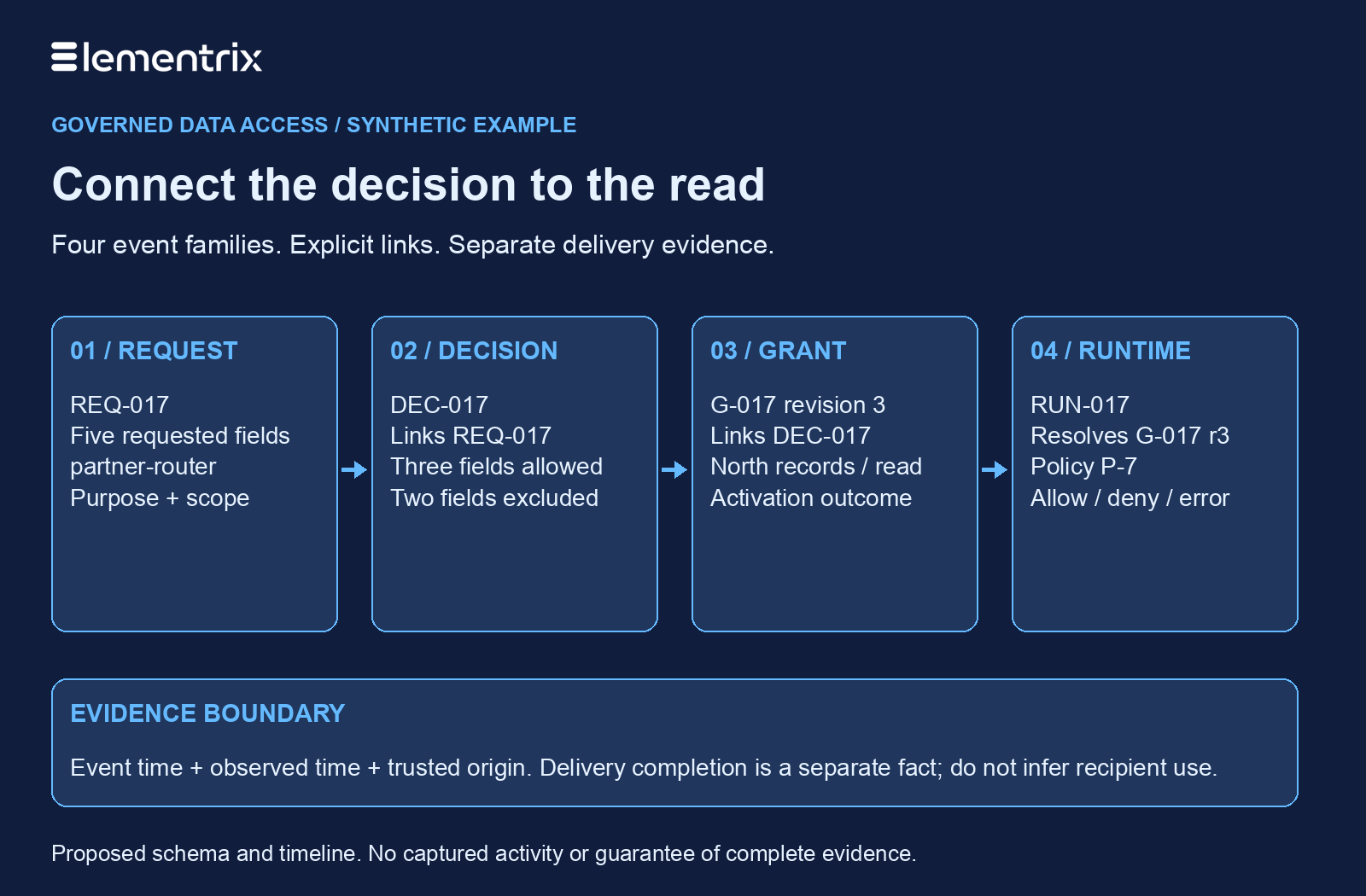
Separate request, decision, grant and consumption events
Treat these as different facts with different owners. A request states the consumer’s desired scope. A decision records what a reviewer allowed. A grant event records a permission change in the implementation. A consumption event records a particular runtime attempt. Preserve denials and relevant failures as well as successful events, according to the purpose of the review.
| Event family | Question it answers | Evidence to keep |
|---|---|---|
| Request | What did the consumer ask for? | Request ID; application or delegated-user context; purpose reference; product; requested fields, records and operations; requested duration. |
| Decision | What was allowed, narrowed or rejected? | Decision ID; reviewer identity or role reference; approved scope; reason code; conditions; review or end trigger; decision time. |
| Grant change | What permission became effective? | Grant ID and revision; source decision; effective interval; assigned consumer; actor; operation result; enforcement or propagation state if known. |
| Consumption decision | What happened on this delivery attempt? | Runtime request ID; authenticated consumer reference; resource and operation; resolved grant/policy/product versions; allow/deny/error; delivered field set reference where available; event time. |
Do not use “approved” as a synonym for “active.” A provisioning step can fail after a reviewer approves the request. Likewise, an allowed authorization decision does not prove a response reached the recipient: a transport failure can occur afterward. If delivery completion matters to your question, record it separately and define whether it means response construction, network write completion or an acknowledgement.
For routing and partial-approval details, see the approval workflow guide. For a failed runtime attempt, the denied-access decision tree helps separate identity, grant and delivery checks.
Capture identity, resource, scope, time and policy version
Choose a stable event envelope and a small set of event-specific attributes. OWASP’s logging guidance emphasizes recording enough context to explain an event while protecting the log itself. The worksheet below is an original design proposal; adapt field names and sensitivity treatment to your system.
| Group | Candidate fields | Design decision |
|---|---|---|
| Identity | actor_ref, consumer_app_ref, delegated_subject_ref | Distinguish the approver from the runtime caller. Use protected references where a direct personal identifier is unnecessary. |
| Resource and scope | product_ref, product_version, operation, record_scope_ref, field_set_ref | Keep an authoritative, retrievable version of the scope. A mutable label alone cannot reconstruct a historic grant. |
| Decision context | decision_id, grant_id, grant_revision, policy_revision, purpose_ref | Link runtime behavior to the rule actually resolved, rather than assuming the latest rule applied. |
| Outcome | decision_outcome, delivery_outcome, reason_code | Use controlled, documented values. Distinguish a denial from a dependency error and from a failed delivery. |
| Time and origin | event_time, observed_time, service_ref, event_schema_version | Record the source clock and collection time separately when useful; define time zone, precision and clock synchronization. |
| Correlation | event_id, access_request_id, runtime_request_id, trace_id | Give each event its own identity and preserve explicit links between the longer approval lifecycle and a shorter runtime trace. |
A field-set reference is useful only if its historical contents remain available for the required review period. If a policy engine does not return a revision, record that limitation and design a reliable version reference. Do not fill the gap with a guessed “current” policy value.
Connect events with correlation identifiers
An approval may take hours and support many later reads. Keep its access-request identifier separate from each runtime request. Use explicit decision and grant links to connect those lifetimes. A distributed trace can help follow one runtime request across services; it does not automatically identify the approval that established the grant.
The OpenTelemetry logs data model distinguishes event and observation timestamps and provides optional trace-context fields. If your stack emits them, retain valid trace and span identifiers alongside your access-domain references. Adding custom access attributes does not make the example below an OpenTelemetry wire-format record.
| Illustrative UTC time | Event | Key references | Meaning |
|---|---|---|---|
| 09:00:00 | access.requested | REQ-017 / partner-router | Five Customer Status fields requested for regional service routing. |
| 09:12:00 | access.decided | DEC-017 / REQ-017 | Reviewer approves id, status and region; excludes email and credit_limit. |
| 09:12:05 | access.grant.changed | G-017 revision 3 / DEC-017 | Implementation reports the narrowed read grant active for assigned north-region records. |
| 09:13:02 | data.read.decided | RUN-017 / G-017 revision 3 / policy P-7 | Serving path reports an allowed decision for the resolved scope. |
| 09:13:03 | data.delivery.completed | RUN-017 / event E-017B | The defined delivery-completion point reports success; recipient storage is outside that fact. |
Keep event identity and ordering explicit. Collectors can deliver events late or more than once. Deduplicate by a documented event identifier, preserve source and observation times, and retain version or sequence information where the source supports it. Never infer a complete chronology solely from arrival order.
Protect evidence and define its retention
Make the log useful without turning it into another broad data export. Restrict read and write privileges, protect transmission, validate untrusted event attributes and monitor collection failures. Review access to evidence and record significant administrative changes. These are design requirements to verify, not a promise that a given storage system is tamper-proof.
Define a retention owner and review purpose for each event family. Align the period with applicable organizational requirements and professional advice where needed; there is no universal duration in this template. Include indexes, backups, archived copies and extracts in the handling plan. Record how deletion and exceptional preservation are controlled.
- Exclude secrets, access tokens and unnecessary sensitive response values from routine events. Protect any narrowly justified diagnostic capture separately.
- Treat a caller-supplied correlation value as untrusted input. Validate format and length and establish trusted identifiers at your boundary.
- Test delayed, duplicated, missing and malformed events. Alert on collection gaps that would prevent the intended review.
- Avoid sampling away the evidence your review requires. Operational telemetry sampling and access-evidence retention can need different policies.
Use a sample event and a reconstruction checklist
This protocol-neutral JSON is a synthetic proposed event. It describes an authorization decision and references a versioned field set; it does not contain a real customer record, credential or successful test result. An actual implementation must establish which attributes it can emit reliably.
{
  "event_schema_version": "example-1",
  "event_id": "E-017A",
  "event_name": "data.read.decided",
  "event_time": "2026-11-08T09:13:02Z",
  "observed_time": "2026-11-08T09:13:03Z",
  "service_ref": "customer-serving-demo",
  "runtime_request_id": "RUN-017",
  "access_request_id": "REQ-017",
  "decision_id": "DEC-017",
  "consumer_app_ref": "partner-router",
  "product_ref": "customer-status",
  "product_version": "v1",
  "grant_id": "G-017",
  "grant_revision": 3,
  "policy_revision": "P-7",
  "operation": "read",
  "record_scope_ref": "north-assigned-v1",
  "field_set_ref": "routing-fields-v1",
  "decision_outcome": "allow",
  "reason_code": "approved_scope"
}
Try to reconstruct one allowed and one denied attempt
- Identify the real caller and any delegated user context, then resolve the product and operation.
- Retrieve the historic scope and policy revision applicable at the event time. Compare requested, approved and effective scope.
- Find the decision, grant-change and runtime records through their explicit links. Note missing or contradictory evidence.
- For a denied attempt, identify the recorded reason and enforcement point without exposing restricted field values to the reviewer unnecessarily.
- Separate authorization outcome, delivery completion and any downstream use. State what the available evidence cannot prove.
If a link is missing, assign an owner to close that gap and repeat the reconstruction. A dashboard showing a count of successful calls is not a substitute for the specific relationship a reviewer needs to examine. For the surrounding operating model, use the zero-trust data access governance guide.
Review the evidence for a sample access decision
Bring one application, product and approval scenario to a walkthrough. Ask which decision and consumption records are available, how they correlate, how sensitive attributes are handled and which gaps remain. Request an Elementrix demo to review the evidence available for your scenario.