
An API gateway manages how requests reach your services. A governed data serving layer applies the data product’s contract to the response: which records and fields the consumer may receive, which version it gets, and how current the data must be. The two roles can run in separate services or share infrastructure. What matters is that each decision has an owner and runs on every relevant path.
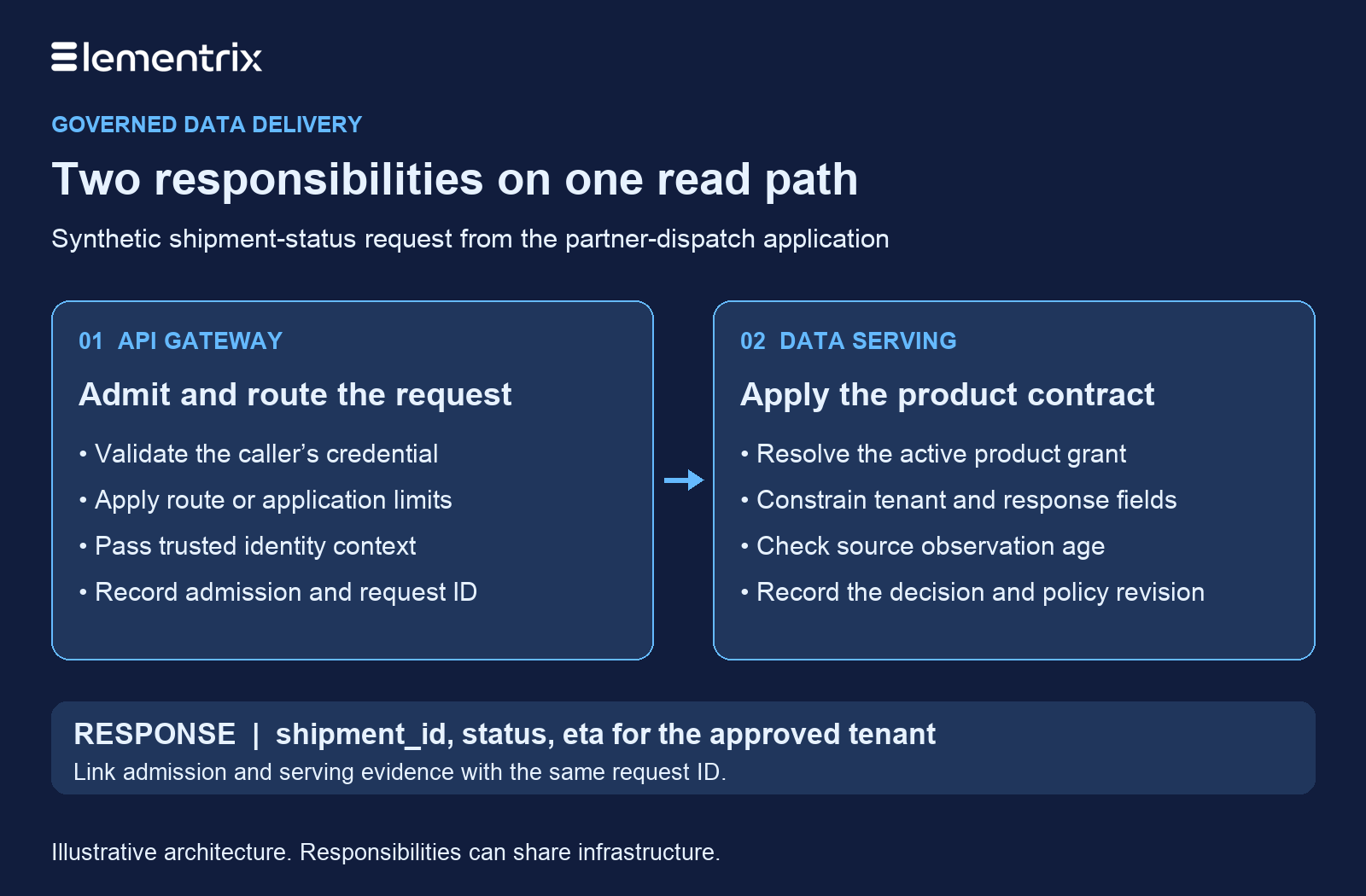
Consider a partner dispatch application that can read shipment status for its own tenant. The gateway can validate its credential, apply a quota and route the request. Something in the delivery path must also resolve the app’s approved tenant and fields, check the age of the shipment snapshot, and record which rules were applied. A successful gateway authentication by itself tells you little about those decisions.
What an API gateway typically controls
A gateway is an entry point for API traffic. It can route an incoming request to the appropriate service, handle transport security, validate credentials, and apply limits. This keeps common controls consistent when several APIs share an entry point. Microsoft’s gateway architecture guidance describes these responsibilities and how they fit a microservices deployment.
Capabilities vary. For example, Amazon API Gateway mapping templates can transform payloads using input and authorizer context. A gateway that can obtain an authoritative grant and enforce its field rules can implement part of the serving role. The design question is who owns that rule, which context it uses, and what happens on routes where the gateway policy does not execute. If endpoint duplication is the larger problem, start with the API sprawl guide.
What a data serving layer needs to know
Here, “data serving layer” means the part of the delivery path that implements the data product contract at read time. It may be a dedicated service, a policy-aware query layer, or code that runs with a gateway. For a shipment product, that contract identifies the product version, the approved consumer, the tenant boundary, the fields the consumer can read, and a freshness rule.
Keep the control that makes the decision close to the data it needs. Use trusted identity context from the gateway or identity provider, and resolve the caller’s access against an authoritative policy. Enforce record scope and the allowed response shape before delivery, including for batch reads and error responses. OWASP’s object property authorization guidance explains why permitted access to an object does not automatically permit every property.
Keep the access approval process distinct from enforcement. A catalog or marketplace can help a team find a product and request access, while the runtime path must apply the resulting grant. See the catalog and marketplace comparison for that handoff.
Map each responsibility to an owner
| Decision | Gateway responsibility | Serving responsibility |
|---|---|---|
| Identity | Validate credentials and pass trusted identity context. | Resolve the application or delegated user to the applicable product grant. |
| Routing and quotas | Select the service and apply route or consumer limits. | Resolve the product version and apply product-specific query limits where needed. |
| Records and fields | Enforce entry or operation rules where configured. | Apply the approved tenant or record predicate and the allowed field projection. |
| Freshness | Observe transport health and apply any configured response caching policy. | Check source observation age and choose the contract’s fallback or unavailable response. |
| Evidence | Record the request ID, route, admission outcome and transport status. | Correlate the product version, policy revision, decision, projection and freshness outcome. |
For delegated calls, document how application identity and user identity combine. A trusted client ID does not tell you whether the user can read the record. The application-level and user-level access comparison gives examples of both patterns.
How the layers work together
Trace one synthetic shipment-status request
Suppose partner-dispatch asks for shipment S-104. Its proposed grant covers tenant north-demo and allows shipment_id, status and eta. The product contract permits a snapshot up to five minutes old. These names, values and outcomes are illustrative design inputs.
- Admit the request. The gateway validates the credential for the API, applies the app quota and routes to the shipment-status service. The service accepts identity context only from a trusted path and rejects caller-supplied substitutes.
- Resolve the grant and query. The serving path checks the app’s product grant, constrains the read to
north-demo, and projects the three approved fields. A request for another tenant’s shipment receives the documented denial or concealed not-found response. - Check the age at delivery. If the source was observed at 09:00 and delivery is attempted at 09:04, the snapshot is within the proposed budget. At 09:06, the example policy returns an unavailable response when no permitted fresher snapshot is available. The cache insertion time does not reset the source observation clock.
- Record the decisions. A shared request ID connects the gateway admission with the grant revision, product version, freshness outcome and serving decision. Keep tokens and sensitive response values out of routine logs.
Put the same checks on cached and alternate paths
Trace a cache hit as carefully as a source read. A shared response cache needs a design that prevents reuse across unauthorized scopes. Depending on the architecture, either apply current authorization and projection after retrieving cached data or partition cached responses by the relevant scope and handle grant changes before reuse. If you cannot establish those guarantees, disable shared caching for that route. A response TTL and a source age budget answer different questions.
Use the cached data versus live APIs guide to set the source-age budget and fallback. The read storm guide covers source-load controls, while the system decoupling guide covers dependencies during core downtime.
A checklist for finding missing responsibilities
Walk through one real API with its gateway owner, data product owner and application owner. Write down the enforcement point, accountable owner, and evidence for each decision in the table. Then use these cases to check the design.
- Identity handoff: Try an untrusted forwarded identity and a valid credential with no product grant. Confirm which component refuses each request.
- Tenant and field scope: Compare requests for the caller’s record and another tenant’s record. Check nested fields, list responses and errors for accidental exposure.
- Cache isolation: Warm the cache as a wider-scope client, then request the same resource as a narrower-scope client. Repeat after changing the grant and check when the new scope takes effect.
- Freshness failure: Interrupt source refresh, cross the age budget and check the documented response. Confirm that repeated cache hits leave the original observation time intact.
- Evidence: Reconstruct an allowed request and a denied request from their IDs. Identify the actual policy version and outcome without relying on sensitive payloads.
If a responsibility has no owner, assign one before moving it into another component. If a test fails only on a batch route, a cache hit or a direct backend call, fix that path and rerun the case. To map these responsibilities against an API in your own stack, request an Elementrix demo.