
Organizations today generate more data than ever before. Applications, APIs, analytics platforms, AI systems, and business processes continuously create and consume information across the enterprise.
As data volumes grow, traditional approaches to managing and delivering data are struggling to keep pace. Centralized teams often become bottlenecks, business users wait weeks for data requests, and organizations face increasing governance and scalability challenges.
This is where the concept of a data product is changing the future of modern data architecture.
Rather than treating data as a byproduct of systems, organizations are increasingly treating data as a product that is designed, governed, documented, and delivered to consumers in a reliable and scalable way.
Why Traditional Data Architecture Is No Longer Enough
For years, organizations relied on centralized data teams to manage reporting, analytics, and data delivery.
While this model worked at smaller scales, modern enterprises face several challenges:
- Rapid growth in data volume
- Increasing demand for self-service analytics
- Complex API ecosystems
- AI and machine learning workloads
- Growing governance requirements
As a result, many organizations struggle to deliver trusted data efficiently.
The shift toward data-as-a-product thinking is helping enterprises overcome these limitations.
👉 Read More : How to Fix Database Performance Issues Fast
What Is a Data Product?
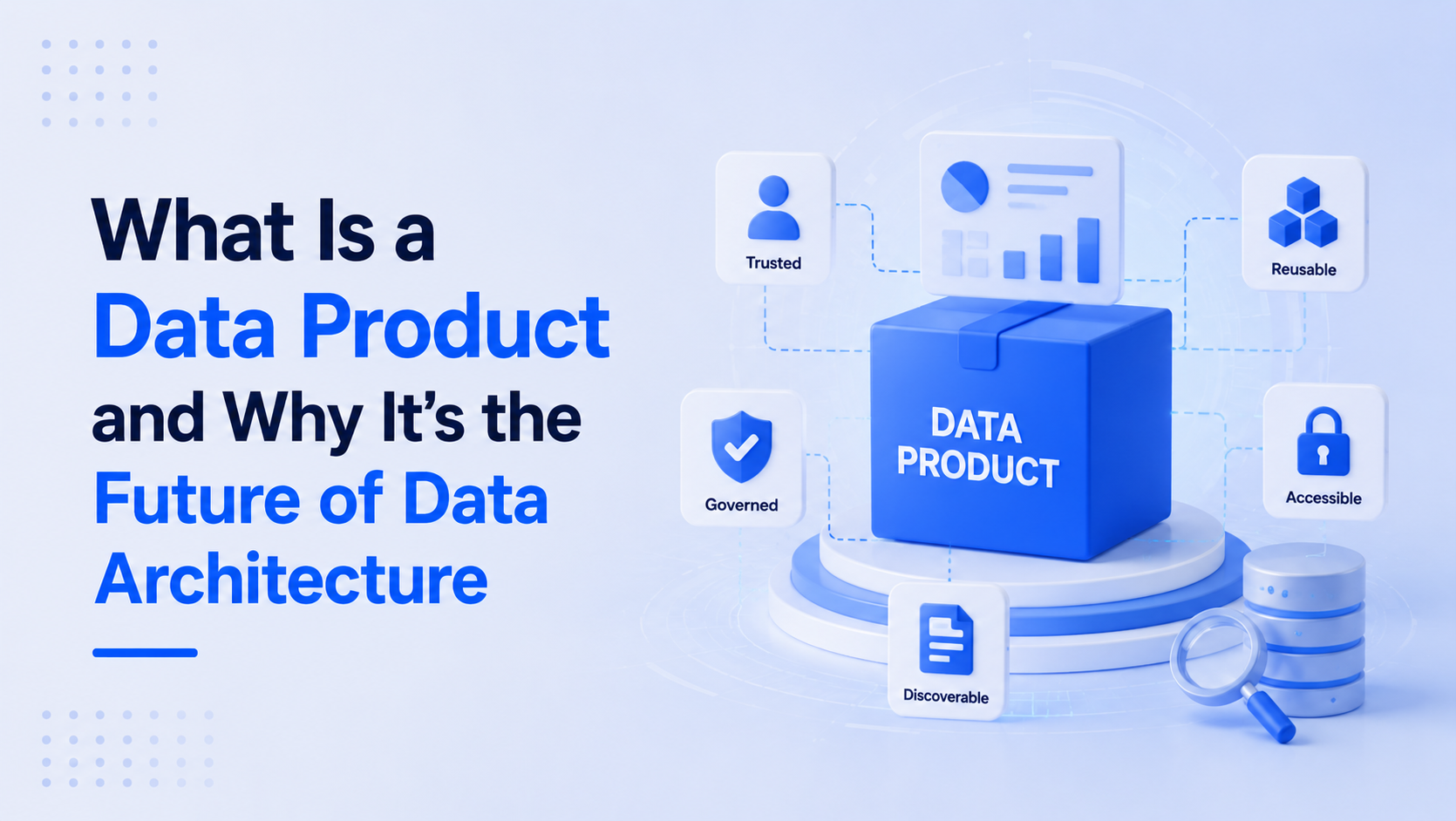
A data product is a reusable, governed, discoverable, and business-ready data asset designed to serve specific users, applications, or business outcomes.
Unlike raw datasets or reports, a data product includes:
- High-quality data
- Metadata and documentation
- Governance policies
- Access controls
- Ownership and accountability
- Service-level expectations
A successful data product is designed with consumers in mind and provides reliable access to trusted information.
To turn these components into a reviewable design, use our data product specification template and worked example to document purpose, ownership, approved fields, schema, service expectations, and change decisions.
Data Product vs Dataset
| Dataset | Data Product |
| Raw data collection | Business-ready asset |
| Limited governance | Governed and documented |
| Often difficult to discover | Easily discoverable |
| Technical ownership only | Business and technical ownership |
| Minimal user experience | Designed for consumers |
Modern organizations increasingly use data products to improve scalability, governance, and self-service access.
👉 Read More : Top Data Governance Challenges and How to Overcome Them
Why Data Products Matter in Modern Enterprises
Organizations adopting data products experience several benefits.
Faster Access to Trusted Data
Business users spend less time searching for data and more time generating insights.
Reduced Dependency on Centralized Teams
Teams can access approved data products without waiting for custom requests.
Better Data Discoverability
Well-documented data products are easier to find and use.
Improved Governance and Security
Built-in policies ensure consistent access control and compliance.
Scalability Across Business Domains
Different business units can own and manage their own data products while maintaining governance standards.
👉 Read More : Top Data Governance Solutions for Secure Data Access
What Is a Data Product Layer?
Understanding the Data Product Layer
A data product layer is the architectural layer that standardizes how data products are published, governed, discovered, and consumed.
It sits between data producers and data consumers.
Instead of consumers accessing raw databases directly, they interact with governed data products through a standardized delivery mechanism.
Benefits of a Data Product Layer
A well-designed data product layer provides:
- Consistent access patterns
- Reusable data assets
- Centralized governance
- Reduced duplication
- Improved security
- Better consumer experience
As enterprises scale, the data product layer becomes a critical component of modern data architecture.
👉 Read More : What Is Data Governance? A Complete Guide
How Do Data Products Work?
A data product moves through several stages during its lifecycle.
Data Producers
Business domains or teams create and maintain the product.
Data Consumers
Users, applications, analytics tools, and AI systems consume the product.
Governance Policies
Policies define access rights, security controls, and compliance requirements.
Access Controls
Permissions ensure that only authorized users can access data.
Metadata and Documentation
Documentation helps users understand how the product should be used.
Together, these components create a trusted and reusable asset that can support multiple business use cases.
Data Product vs Traditional Data Delivery
Traditional Data Architecture
Traditional approaches often rely on:
- Centralized bottlenecks
- Manual data requests
- Duplicate integrations
- Inconsistent governance
This creates operational inefficiencies and slows decision-making.
👉 Read More : Best Data Governance Tools
Data Product Architecture
Data product architectures focus on:
- Self-service access
- Standardized delivery
- Domain ownership
- Built-in governance
- Consumer-centric design
This approach enables organizations to scale data delivery more effectively.
Data Product Examples in Real-World Enterprises
A common question is:
What does a data product example look like?
Several examples exist across industries.
Customer Data Product
Provides trusted customer profiles for marketing, sales, and support teams.
Financial Reporting Data Product
Delivers standardized financial metrics for reporting and compliance.
Sales Analytics Data Product
Supports revenue tracking and forecasting.
Product Usage Data Product
Provides insights into customer engagement and adoption.
AI and Machine Learning Data Products
Deliver trusted training datasets for AI applications.
These examples demonstrate how data products create reusable business value.
👉 Read More : Build an Internal Data Marketplace with Governance
The Relationship Between Data Products and Data Mesh
What Is Data Mesh?
Data mesh is a modern architectural approach that decentralizes data ownership across business domains.
Instead of relying on centralized data teams, domain experts own and manage their data assets.
How Data Products Enable Data Mesh
Data products are the foundation of data mesh.
They support:
- Domain ownership
- Federated governance
- Self-service infrastructure
- Standardized delivery
Without data products, data mesh cannot operate effectively.
👉 Read More : What Is Data Access Control
Why Data Mesh Depends on Data Products
Data mesh requires every domain to publish trusted, governed, and discoverable data assets.
These assets are data products.
This is why data products are considered a core pillar of data mesh architecture.
How Data Products Improve Data Architecture
Modern data architecture benefits significantly from data products.
Reducing Data Silos
Data products make information easier to discover and share.
Improving Data Quality
Ownership and governance improve reliability.
Increasing Scalability
Organizations can scale access without overwhelming centralized teams.
Supporting Real-Time Data Access
Consumers receive data faster and more consistently.
Enhancing Governance
Policies are embedded directly into the product lifecycle.
👉 Read More : Enterprise Data Monetization Strategy with Governed Delivery
The Role of Data Platforms in Delivering Data Products
A modern data platform plays a critical role in supporting data products.
Key capabilities include:
Metadata Management
Improves discoverability and trust.
Governance Enforcement
Applies security and compliance controls.
Access Control
Ensures authorized usage.
Data Discovery
Helps users find and consume products efficiently.
Modern data platforms are increasingly designed around product-oriented delivery models.
Common Challenges When Implementing Data Products
Organizations may encounter several challenges.
- Lack of ownership
- Poor documentation
- Weak governance
- Limited discoverability
- Inconsistent standards
- Adoption resistance
Addressing these challenges requires strong governance and clear operating models.
👉 Read More : Governed AI Data Access for Enterprise Copilots
Best Practices for Building Successful Data Products
Treat Data as a Product
Focus on user needs and business outcomes.
Assign Domain Ownership
Establish accountability for quality and maintenance.
Focus on User Experience
Make products easy to discover and consume.
Build Governance into the Product
Security and compliance should be integrated from the beginning.
Maintain Documentation and Metadata
Trust depends on transparency.
Monitor Usage and Performance
Continuously improve based on consumer feedback.
👉 Read More : Fix Database Performance Issues Without Scaling Costs
How Elementrix Enables Data Products at Scale
Organizations need more than datasets—they need governed, discoverable, and reusable data products.
Elementrix helps organizations build and manage governed data products through a secure data marketplace, centralized governance controls, and scalable data delivery architecture.
Elementrix enables:
- Governed data products
- Secure data access
- Centralized governance
- Data marketplace capabilities
- Enterprise-grade delivery
This helps enterprises scale data operations while maintaining security and compliance.
Why Data Products Are the Future of Enterprise Data Architecture
Many trends are driving the adoption of data products.
Growing Demand for Self-Service Access
Users expect faster access to trusted information.
Increasing Governance Requirements
Organizations need stronger security and compliance controls.
AI and Analytics Workloads
Modern workloads require reusable and governed data assets.
Faster Decision-Making
Business teams need immediate access to reliable information.
Evolution of Data Organizations
Data teams are shifting from service providers to product builders.
For these reasons, data products are rapidly becoming the foundation of modern enterprise data architecture.
Future Trends in Data Products
Several emerging trends are shaping the future.
- AI-ready data products
- Automated governance
- Data product marketplaces
- Policy-driven delivery
- Data product monetization
- Enterprise-wide self-service ecosystems
Organizations investing in these capabilities today will be better positioned for future growth.
Frequently Asked Questions
What is a data product?
A data product is a reusable, governed, and discoverable data asset designed to deliver business value to data consumers.
What is a data product layer?
A data product layer is the architecture layer that standardizes how data products are published, governed, and consumed across the enterprise.
How do data products work?
Data products combine data, metadata, governance policies, access controls, and documentation into a reusable asset that can be consumed by users, applications, and AI systems.
Why use data products?
Data products improve scalability, governance, discoverability, and self-service access while reducing operational bottlenecks.
How are data products related to data mesh?
Data products are a core component of data mesh architecture, enabling domain-oriented ownership and decentralized data management.
Build Governed Data Products with Elementrix
Modern enterprises need more than dashboards and datasets—they need governed, discoverable, and reusable data products.
Elementrix provides a secure data marketplace and governance platform that helps organizations create, manage, and scale enterprise data products while maintaining security, compliance, and operational control.
Start building your data product strategy with Elementrix today.
Final Thoughts
As organizations continue to scale their data operations, traditional data architectures often struggle to meet growing demands for speed, governance, and self-service access.
A data product provides a modern approach to delivering trusted, reusable, and governed data assets that support analytics, AI, and business operations.
By combining strong governance, domain ownership, and scalable delivery models, data products are becoming the foundation of modern data architecture.
With Elementrix , enterprises can accelerate their journey toward a data product-driven future through secure access, centralized governance, and enterprise-ready data delivery.