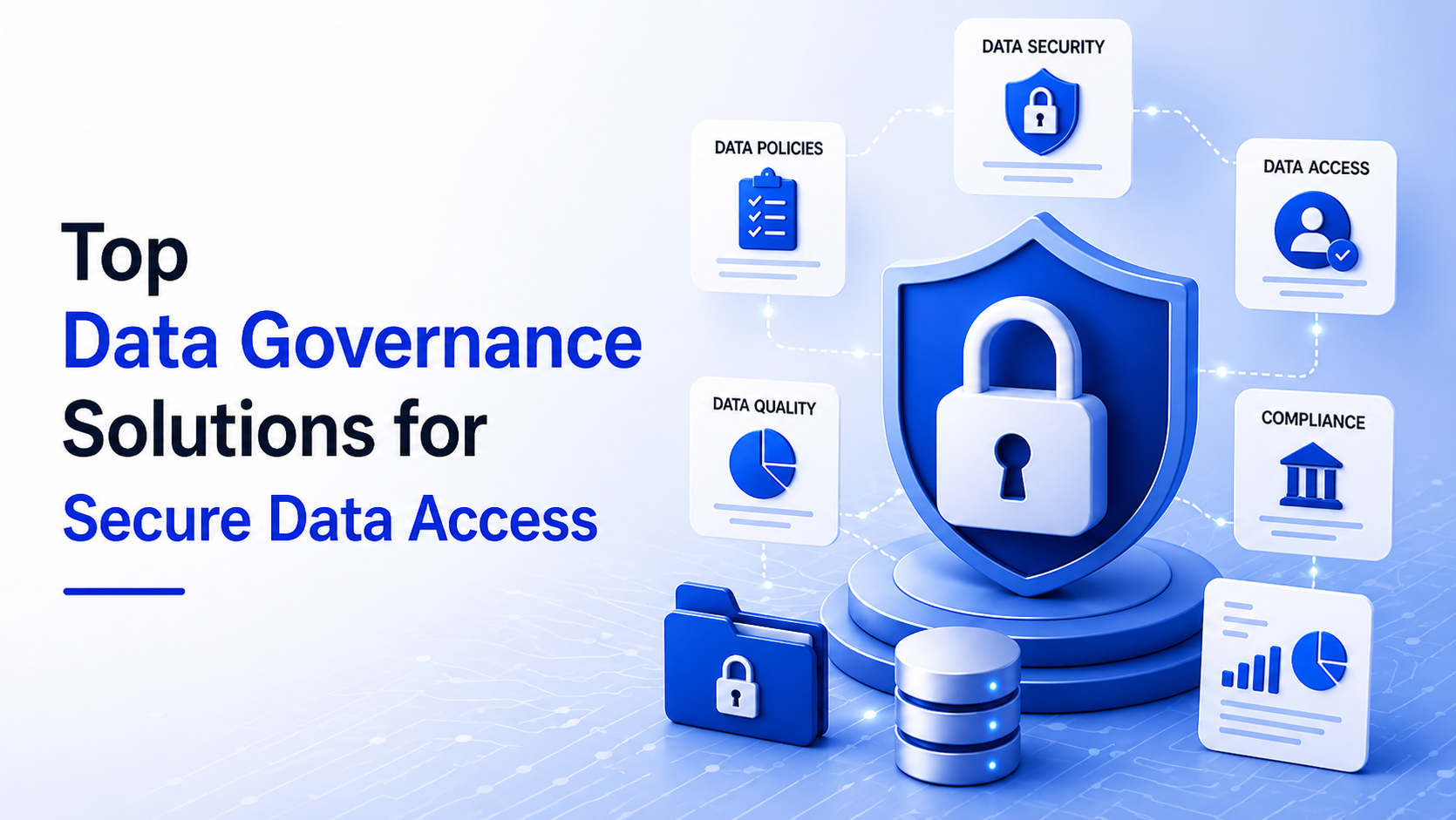
In today’s data-driven enterprises, managing data is no longer enough — controlling access to data is what truly matters.
Organizations are dealing with:
- Increasing data volumes
- More users and systems accessing data
- Stricter compliance requirements
Without the right approach, this leads to data exposure, security risks, and compliance failures.
That’s why modern companies are investing in data governance solutions — not just to manage data, but to secure and control it at scale.
What Are Data Governance Solutions?
If you’re asking, “What are data governance solutions?” — they are systems designed to help organizations:
- Control data access
- Define governance policies
- Ensure compliance
- Improve data security
Unlike traditional tools, modern data governance platforms go beyond documentation and provide real enforcement of policies.
They combine capabilities from:
- data governance tools
- data security solutions
- data compliance solutions
Into a unified system that ensures data is both usable and secure.
Why Data Governance Solutions Matter Today
Modern organizations face a growing challenge:
👉 Too many people accessing too much data.
This leads to:
- Overexposed sensitive data (PII, financial data)
- Lack of visibility into who accessed what
- Increased compliance risk
This is why enterprise data governance solutions are becoming critical.
They help organizations:
✅ Minimize data exposure
✅ Enforce access policies
✅ Track and audit data usage
✅ Ensure compliance across systems
How Data Governance Solutions Improve Security
One of the most common questions is:
“How do governance solutions improve security?”
The answer lies in control.
Modern data security solutions built into governance platforms enable:
✔️ Fine-Grained Access Control
Instead of giving full access, users only see the data they need.
✔️ Policy-Based Enforcement
Access rules are applied automatically — not manually.
✔️ Auditability
Every data access request is tracked and recorded.
✔️ Data Protection
Sensitive fields can be masked, tokenized, or restricted.
This transforms governance from a static process into active security enforcement.
What Features Should a Data Governance Solution Have?
If you’re wondering, “What features should a governance solution have?” — here are the key capabilities:
1. Data Access Control
Control who can access what data, at what level.
2. Data Visibility
Understand where your data lives and how it’s used.
3. Policy Management
Define and enforce governance rules consistently.
4. Audit & Compliance
Support regulatory requirements with full traceability.
5. Scalability
Handle growing data and users without losing control.
The best data governance platforms combine all of these into one system.
Types of Data Governance Solutions
Not all data governance solutions are the same.
Here are the main categories:
1. Data Governance Tools
Standalone tools focused on specific functions like cataloging or quality.
2. Data Governance Platforms
Integrated systems that manage governance across the organization.
3. Data Security Solutions
Focused on protecting sensitive data and controlling access.
4. Data Compliance Solutions
Designed to meet regulatory requirements like GDPR and HIPAA.
The most effective approach combines all of these into a unified solution.
Enterprise Data Governance Solutions: What Changes at Scale?
At enterprise scale, governance becomes more complex.
Enterprise data governance solutions must handle:
- Multiple data sources
- Multiple teams and roles
- Cross-system access
- Strict compliance requirements
At this level, governance is not just about visibility —
it’s about enforcement and control.
How to Implement Data Governance Solutions
If you’re asking, “How to implement data governance solutions?” — here’s a practical approach:
1️⃣ Identify Sensitive Data
Start with high-risk datasets (PII, financial data).
2️⃣ Define Access Policies
Who can access what, under which conditions.
3️⃣ Apply Control Mechanisms
Use tools that enforce policies at runtime.
4️⃣ Monitor and Audit
Track data usage continuously.
5️⃣ Scale Gradually
Expand governance across systems and teams.
The key is not to start everywhere —
but to start where risk is highest.
Common Mistake: Governance Without Enforcement
Many organizations invest in data governance tools but still rely on:
- Manual approvals
- Emails and spreadsheets
- Disconnected systems
This creates a gap between policy and execution.
True governance requires:
👉 Automated enforcement
👉 Centralized control
👉 Full auditability
The Future of Data Governance Solutions
Modern data governance solutions are evolving toward:
- Field-level access control
- Policy-driven data access
- “One data product, multiple governed views”
Instead of duplicating data or creating multiple APIs, organizations are focusing on controlled data access.
This is the future of scalable and secure data governance.
Take Control of Your Data Governance
If your organization is still managing governance through disconnected tools and manual processes —
you’re not really controlling your data.
You need a solution that:
- Enforces access policies automatically
- Controls data at the field level
- Provides full auditability
- Scales with your data architecture
👉 Discover how Elementrix enables secure, policy-driven data governance:
🔗https://elementrix.io/
FAQs
What are data governance solutions?
They are systems that help organizations control, secure, and manage data access with policies and governance frameworks.
What is the best data governance solution?
The best solution is one that provides real-time enforcement, fine-grained access control, and full auditability.
How do governance solutions improve security?
They limit access to sensitive data, enforce policies automatically, and track all data usage.
What features should a governance solution have?
Access control, policy enforcement, auditability, scalability, and data visibility.
How to implement data governance solutions?
Start with high-risk data, define policies, enforce controls, monitor usage, and scale gradually.
Final Thoughts
The best data governance solutions don’t just help you manage data —
they help you control access to it.
Because in modern data platforms:
👉 Visibility is important
👉 Control is critical
And the organizations that master both are the ones that scale securely.