
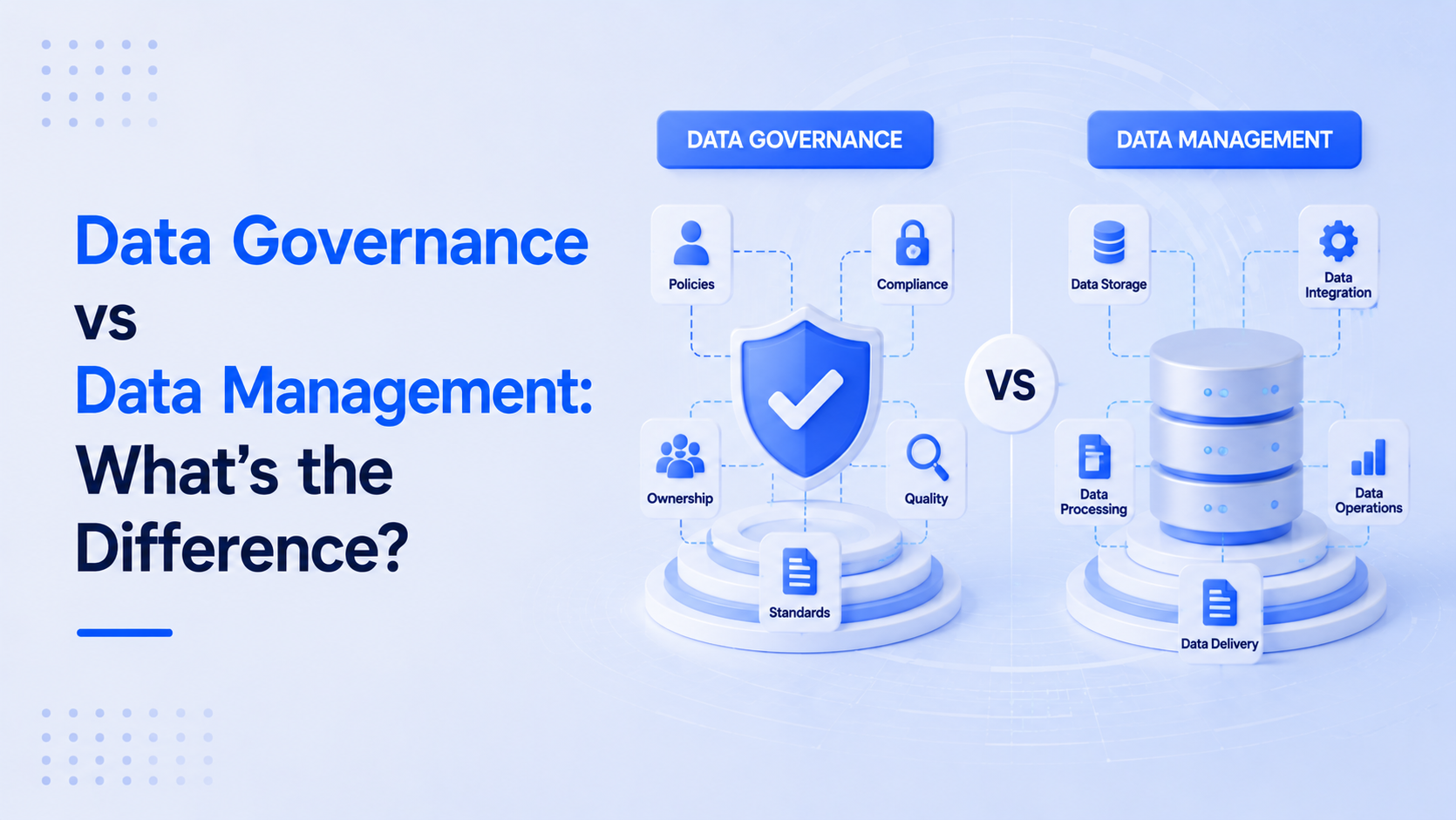
As organizations generate and consume more data than ever before, the need for effective data practices has become a top priority. However, many businesses still struggle to understand the difference between data governance vs data management.
While these terms are often used interchangeably, they serve very different purposes. Understanding how governance and management work together is essential for maintaining data quality, security, compliance, and operational efficiency.
In this guide, we’ll explore the key differences between data governance and data management, explain why both matter, and show how modern organizations can build a successful data strategy that combines both disciplines.
Why Understanding Data Governance vs Data Management Matters
Enterprise data has become one of the most valuable business assets.
Organizations rely on data to:
- Drive business decisions
- Power analytics and AI
- Improve customer experiences
- Support compliance requirements
- Enable digital transformation
Despite this, many organizations confuse governance and management. This misunderstanding often leads to poor data quality, security gaps, inconsistent ownership, and compliance risks.
The reality is simple:
Data governance and data management serve different functions, but both are critical for a successful data strategy.
👉 Read More : How to Fix Database Performance Issues Fast
What Is Data Governance?
Data Governance Definition
Data governance is the framework of policies, standards, roles, and processes that define how data should be managed across an organization.
Its primary purpose is to ensure that data remains:
- Accurate
- Secure
- Compliant
- Consistent
- Trusted
Governance establishes accountability and ownership for data assets and provides the rules that guide how data is used.
Data governance is primarily a business function focused on control, oversight, and decision-making.
👉 Read More : Top Data Governance Challenges and How to Overcome Them
Core Components of Data Governance
Policies and Standards
Organizations establish rules that govern how data is collected, stored, shared, and protected.
Compliance Requirements
Governance helps ensure adherence to regulations such as GDPR, HIPAA, and industry-specific standards.
Data Quality Oversight
Governance frameworks define quality expectations and monitoring processes.
Access Control and Security
Governance determines who can access data and under what conditions.
👉 Read More : Top Data Governance Solutions for Secure Data Access
What Is Data Management?
Data Management Definition
The data management definition refers to the technical and operational processes used to collect, store, organize, process, and deliver data.
While governance defines the rules, management executes them.
Data management includes:
- Data storage
- Data integration
- Data processing
- Data delivery
- Data maintenance
It focuses on making data available, reliable, and usable for business operations.
Core Components of Data Management
Data Integration
Combining information from multiple sources.
Data Storage
Managing databases, data warehouses, and cloud storage.
Data Pipelines
Moving data between systems efficiently.
Data Operations
Monitoring and maintaining data environments.
Metadata Management
Tracking information about data assets and their usage.
👉 Read More : What Is Data Governance? A Complete Guide
Data Governance vs Data Management: Key Differences
Understanding data governance vs data management requires recognizing their distinct responsibilities.
Governance vs Management Explained
Governance defines the rules.
Management executes the rules.
Governance focuses on strategic oversight, while management focuses on operational execution.
| Data Governance | Data Management |
| Defines policies | Executes processes |
| Focuses on control | Focuses on operations |
| Business-oriented | Technical-oriented |
| Ensures compliance | Delivers and maintains data |
| Establishes standards | Implements standards |
This distinction explains the broader concept of governance vs management across enterprise systems.
Data Control vs Management: Understanding the Relationship
What Is Data Control?
Data control refers to mechanisms that ensure data is used securely and appropriately.
This includes:
- Security policies
- Access governance
- Compliance enforcement
How Data Management Supports Data Control
Strong data management enables data control through:
- Operational implementation
- Monitoring and auditing
- Security enforcement
- Data lifecycle support
This relationship highlights the connection between data control vs management.
👉 Read More : Best Data Governance Tools
Why Data Governance Is Important
Effective governance delivers significant business value.
Improving Data Quality
Governance establishes quality standards and accountability.
Enhancing Compliance
Organizations can meet regulatory obligations more effectively.
Reducing Security Risks
Access policies reduce unauthorized data exposure.
Establishing Accountability
Clear ownership improves decision-making and trust.
Supporting Business Trust
Reliable data improves confidence across teams.
👉 Read More : Build an Internal Data Marketplace with Governance
Why Data Management Is Important
Data management ensures data remains usable and accessible.
Reliable Data Delivery
Users receive timely access to trusted information.
Operational Efficiency
Automated processes reduce manual effort.
Scalability
Organizations can handle growing data volumes.
Analytics and AI Readiness
Well-managed data supports advanced analytics and AI initiatives.
Performance Optimization
Efficient systems improve user experiences.
👉 Read More : What Is Data Access Control
How Data Governance and Data Management Work Together
Governance and management are most effective when they work together.
Governance Sets the Rules
Policies, standards, and ownership structures are established.
Management Implements the Rules
Technical teams operationalize governance requirements.
Shared Responsibility for Data Success
Business and technical stakeholders collaborate to maintain trusted data.
Creating a Unified Data Strategy
Organizations achieve better outcomes when governance and management are aligned.
👉 Read More : Governed AI Data Access for Enterprise Copilots
The Role of Data Lifecycle Management
What Is Data Lifecycle Management?
Data lifecycle management is the process of managing data from creation to deletion.
Data Lifecycle Stages
Creation
Data is generated or collected.
Storage
Information is stored securely.
Usage
Users and applications access data.
Sharing
Data is distributed to authorized consumers.
Archiving
Inactive data is retained for future needs.
Deletion
Data is removed when no longer required.
Governance and Management Across the Lifecycle
Governance establishes policies for each stage, while management executes those policies operationally.
Enterprise Data Management in Modern Organizations
What Is Enterprise Data Management?
Enterprise data management is the coordinated approach to managing data across the entire organization.
It aligns governance, operations, technology, and business objectives.
👉 Read More : What Is a Data Product
Benefits of Enterprise Data Management
Consistency
Standardized processes improve reliability.
Scalability
Organizations can support growth more effectively.
Security
Centralized controls reduce risk.
Better Decision-Making
Trusted data leads to better business outcomes.
Common Challenges Organizations Face
Many organizations encounter challenges such as:
- Weak governance policies
- Poor data quality
- Data silos
- Inconsistent ownership
- Limited visibility
- Compliance risks
Addressing these issues requires both governance and management capabilities.
Best Practices for Balancing Governance and Management
Organizations should:
Define Clear Ownership
Assign accountability for data assets.
Standardize Policies
Create consistent governance frameworks.
Implement Governance Controls
Enforce policies operationally.
Automate Data Management Processes
Reduce manual effort and errors.
Monitor Compliance and Performance
Continuously assess effectiveness.
Improve Data Discoverability
Help users find trusted information quickly.
How Modern Data Platforms Support Governance and Management
Modern data platforms provide capabilities such as:
- Metadata management
- Access governance
- Data discovery
- Auditability
- Policy enforcement
- Self-service data access
These capabilities help organizations scale both governance and management efforts.
How Elementrix Helps Organizations Govern and Manage Data
Modern enterprises need solutions that connect governance and operations.
Elementrix helps organizations bridge the gap between data governance and data management through governed data products, centralized access controls, secure data delivery, and enterprise-grade governance capabilities.
Elementrix supports:
- Governed data products
- Secure data access
- Centralized governance
- Data marketplace capabilities
- Enterprise-scale data delivery
Organizations can also leverage Elementrix to improve access governance, enterprise data management, and data lifecycle management.
The Future of Data Governance and Data Management
Several trends are shaping the future:
AI-Driven Governance
Automated oversight and monitoring.
Automated Policy Enforcement
Real-time compliance controls.
Real-Time Data Controls
Dynamic access and security policies.
Data Products and Data Mesh
Scalable, domain-driven architectures.
Self-Service Enterprise Data Platforms
Faster access to trusted data.
Governed AI Data Access
Secure data delivery for AI systems.
Frequently Asked Questions
What is data governance vs data management?
Data governance defines the policies, rules, and standards for managing data, while data management handles the operational processes required to store, process, and deliver data.
What is data management?
Data management is the practice of collecting, storing, organizing, integrating, and maintaining data to support business operations and analytics.
Why are both important?
Governance ensures data is trusted, secure, and compliant, while management ensures data is available, accurate, and usable.
How do they work together?
Data governance establishes the rules and policies, while data management implements those rules through technical processes and operational workflows.
Which comes first: governance or management?
Governance should define the framework and standards first, while management executes and maintains those standards across systems and processes.
Modernize Data Governance and Data Management with Elementrix
Successful data strategies require both strong governance and efficient management.
Elementrix helps organizations unify governance and management through governed data products, secure access controls, centralized policies, and scalable enterprise data delivery.
Start building a more trusted and scalable data foundation with Elementrix today.
Final Thoughts
Understanding the difference between data governance vs data management is essential for building a successful modern data strategy.
While governance focuses on defining policies, ownership, compliance, and accountability, management focuses on the operational execution of data processes and delivery.
Organizations that effectively combine governance and management can improve data quality, strengthen security, support compliance, and accelerate business innovation.
With Elementrix, enterprises can create a unified approach to governing, managing, and delivering trusted data at scale.