
Partner data onboarding should end with a verified, limited delivery path and a named owner for the relationship. Record the partner’s purpose, application identity, approved records and fields, operating expectations, launch checks, expiry, and offboarding evidence. A signed agreement or a successful login alone does not establish that the right data reaches the right consumer.
Use the checklist below to review one external application before launch. It is an operational planning aid: adapt the decisions to your data, delivery method, and organizational requirements. Example partners, identifiers, interfaces, limits, and dates are synthetic design choices, not customer results or promised Elementrix settings.
External onboarding adds responsibilities beyond an internal access request. Your team needs a verified counterpart, an agreed use of the delivered data, a support path across organizations, and a way to close access without assuming that copies already delivered disappear. NIST SP 800-47 Rev. 1 frames information-exchange protection across the period before, during, and after an exchange, rather than tying it to one connection technology.
Document purpose, owner, and allowed use
Start with a concrete task. “Give the partner customer data” leaves too much undecided. “Let the partner’s scheduling application read status for its assigned service orders” gives reviewers something to evaluate. Specify excluded uses, such as onward distribution, marketing, or training a model, where they are outside the proposed arrangement.
Name an internal relationship sponsor, a data owner who approves scope, a delivery operator, and a partner technical owner. Replace role labels with accepted contacts in your working record. One person may hold several roles, but an unassigned responsibility should not disappear between the commercial and engineering teams.
Connect commercial and policy decisions to technical scope
Ask the appropriate legal, privacy, security, and commercial reviewers to decide the applicable terms, restrictions, and approvals. Record the approved agreement reference, supported uses, permitted recipients, retention decisions, and any conditions that affect delivery. The checklist does not determine legal authority or establish compliance.
A fee, contract signature, or relationship status is not itself a field-level authorization. Translate the accepted scope into a maintained grant and test its effect. If the business purpose changes, reopen the relevant approvals. For revenue strategy, use our data monetization strategy guide; this article focuses on getting one partner safely into operation.
Use a partner onboarding checklist with owners and evidence
Copy this table into a launch record. For each row, record the decision, responsible contact, evidence location, reviewer, and date. “Not applicable” needs a reason. An unresolved item needs an owner and due date; anything that prevents a clear access decision or safe operation should hold the launch.
| Decision to complete | Accountable role | Evidence to retain |
|---|---|---|
| Purpose and relationship | Relationship sponsor | Verified partner entity; supported task; excluded uses; internal and partner owners. |
| Terms and conditions | Designated review owner | Accepted agreement and review references; permitted recipients, use, retention, and unresolved conditions. |
| Identity and environment | Identity owner | Partner organization mapped to application identity; production and test separation; credential provisioning and rotation responsibilities. |
| Record and field scope | Data owner | Approved product/version, row boundary, allowed field set, exclusions, and the authorization decision reference. |
| Meaning and delivery | Product owner | Field definitions; schema; delivery interface; errors; source/freshness basis; consumer acceptance. |
| Capacity and limits | Delivery owner | Agreed request, export or volume limits; expected workload; retry/backoff behavior; overload handling. |
| Permission checks | Security review owner | Permitted and denied cases, observed outcomes, environment, grant revision, and remaining issues. |
| Operational acceptance | Launch owner | Partner acceptance; monitoring and support path; escalation contacts; recovery and rollback decision. |
| Expiry and renewal | Relationship sponsor | Expiry timestamp; renewal approver; review reminders; expected behavior if renewal is not accepted. |
| Incidents and closure | Relationship sponsor | Incident coordination path; access shutdown responsibilities; retained-copy disposition; closure checks and acknowledgements. |
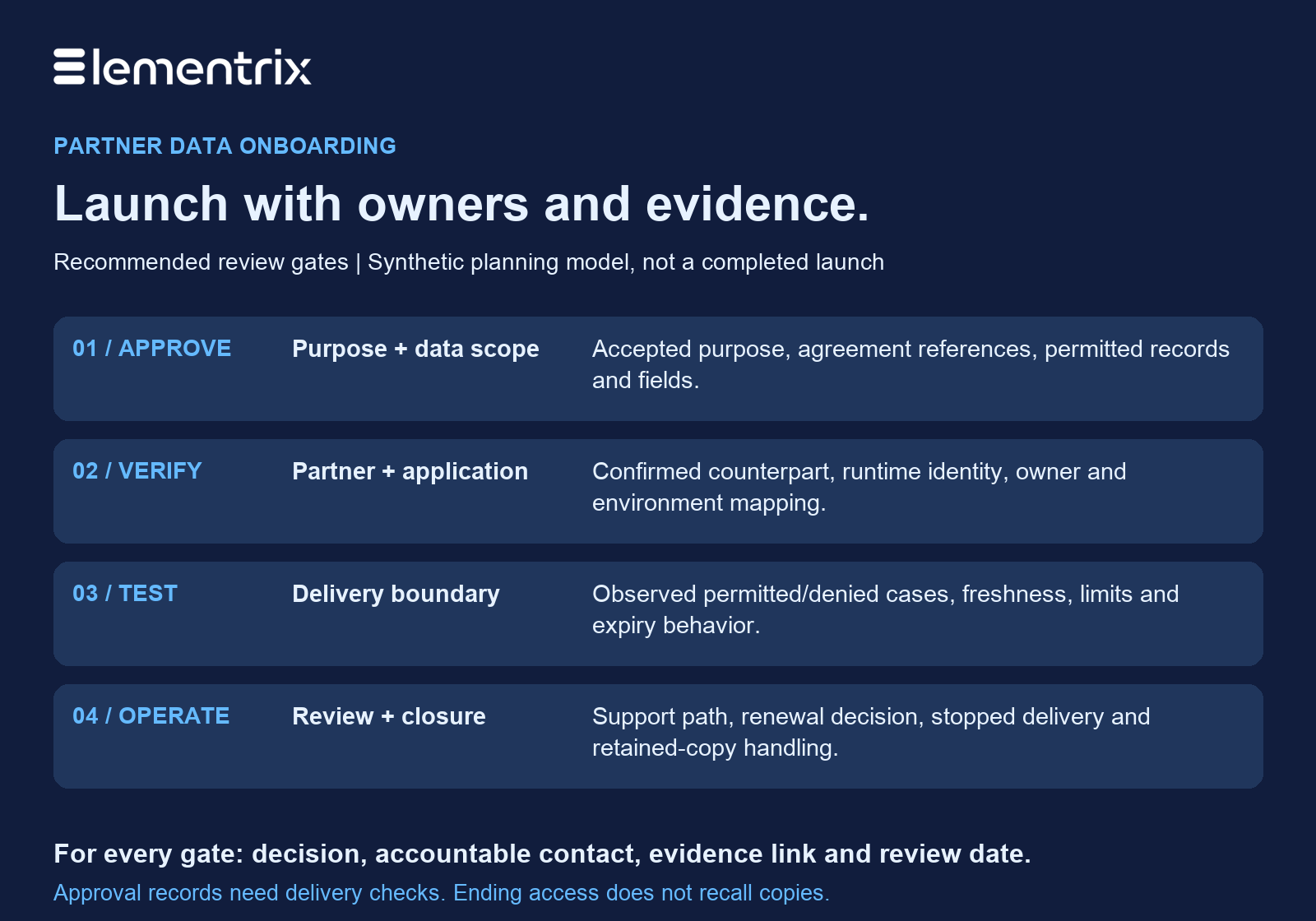
Confirm partner and application identities
Confirm the partner entity and the person authorized to coordinate the integration through your established onboarding process. Then identify the actual runtime consumer. A partner employee’s account, the partner’s service application, and your internal operator are different identities with different responsibilities.
Document whether the interface uses a service identity or delegated user access. Map the partner organization, application, owner, environment, and purpose to its grant. Avoid a shared credential that makes independent attribution and revocation difficult. Keep credential values out of tickets, approval tables, example payloads, and ordinary logs; use the approved secret-management and delivery process.
Test identities should receive synthetic or separately approved test data. Passing a sandbox check does not establish that the production identity has the same scope. Review production configuration explicitly and distinguish credential rotation from a scope change: replacing a secret does not automatically remove an application’s permissions.
Our guide to application-level versus user-level access explains these identity choices. For routing the approval itself, use the data access approval workflow.
Agree fields, delivery, freshness, and limits
A filled synthetic partner record
Consider Partner Atlas, a fictional service partner. Its scheduling application needs service-order status for its own assigned work. The following record proposes a limited pilot; every number and date is illustrative and must be replaced with accepted commitments before use.
| Item | Proposed decision |
|---|---|
| Purpose and owners | Schedule assigned service work. Internal sponsor: Partner Operations. Scope approver: Service Data Owner. Partner application owner: Atlas Scheduling team. |
| Identity and scope | Production application atlas-scheduler; only orders assigned to partner key PARTNER-ATLAS. Enforce the mapping at delivery; do not trust a caller-supplied partner key as authorization. |
| Approved fields | order_ref, service_status, window_end, and product_as_of. Exclude customer names, addresses, contact details, payment information, and free-text notes. |
| Meaning and interface | One current row per opaque order reference. Status describes the service workflow, not payment or customer consent. Illustrative read-only JSON lookup: GET /v1/partner-service-orders/{order_ref}. |
| Freshness and failure | Proposed maximum source-checkpoint age: 15 minutes at delivery. product_as_of represents source coverage, not just processing time. Once stale or coverage is unknown, return a documented unavailable response and alert the delivery operator. |
| Limits and pilot | Proposed cap: 60 lookup requests per minute per application; agree error and backoff behavior. Pilot expiry: 2026-11-26T06:00:00Z. Renewal requires an explicit scope and purpose review. |
A synthetic approved response could be:
{
  "order_ref": "ORD-EX-271",
  "service_status": "scheduled",
  "window_end": "2026-10-27T10:00:00Z",
  "product_as_of": "2026-10-27T06:00:00Z"
}
Keep record scope and field scope separate. An assigned order does not authorize all its attributes. An approved field does not authorize every partner’s orders. OWASP’s property-level authorization guidance reinforces the need to restrict exposed properties to what the consumer should receive.
Agree what happens on missing records, denied requests, stale data, throttling, and interface changes. Select non-disclosing behavior for out-of-scope identifiers where appropriate. If the partner stores responses, include that storage, its permitted use, and its lifecycle in the review. API controls cannot govern every subsequent action on an uncontrolled copy.
Test permissions before launch
Write acceptance cases against the approved record, then execute them in the relevant environment. The table below is a proposed test plan, not a report of tests performed.
| Case | Expected behavior to agree | Evidence needed |
|---|---|---|
| Assigned order | Atlas receives exactly its approved fields for an assigned order. | Sanitized response, identity, grant revision, interface version, timestamp, and result. |
| Another partner’s order | No order data is exposed; response follows the agreed denial/non-disclosure design. | Negative-case request and response metadata; no real sensitive payload in the review record. |
| Excluded attributes | Names, contact details, and notes remain absent, including nested values and error output. | Response inspection across supported lookup, error, export, or alternate paths. |
| Stale, limited, or unavailable service | Documented freshness and capacity behavior; partner retries do not bypass limits. | Controlled scenarios, measured responses, operator notification and partner handling. |
| Expiry or revoked grant | Future delivery stops according to the agreed enforcement model and timing. | Checks across relevant tokens, sessions, delivery nodes and caches; observed effective time. |
Record who accepted each result and which gaps remain. Recheck the production mapping before launch, and make rollback or access shutdown responsibilities clear. A successful sample response proves only the case exercised; it does not cover excluded fields, other partner identities, or expiry.
Review expiry, offboarding, and incidents
Schedule review while the partnership is active. Reopen scope when purpose, ownership, application identity, sources, fields, or onward recipients change. Review whether the partner still uses the product and whether actual consumption matches the agreed delivery pattern. Renewal should affirm continuing need rather than merely extending an old date.
Plan closure before launch: identify the grants, credentials, sessions, subscriptions, exports, and delivery jobs that must stop. Check actual denial after the change; propagation, token validation, caches, and in-flight work may affect enforcement timing. Do not promise instantaneous revocation without evidence for the specific path.
Address copies separately. Identify retained files, application stores, backups, and any permitted downstream recipients; follow the agreed retention, return, deletion, or exception process. Keep the appropriate closure acknowledgement and unresolved exceptions. Ending API access does not recall information previously delivered.
For incidents, agree who can contact whom, who can suspend delivery, what evidence each side preserves, and who authorizes resumption. Exercise the coordination path using a synthetic scenario. Route legal or reporting decisions to the designated specialists instead of treating a generic checklist as a jurisdiction-specific rule.
Map one partner scenario with the Elementrix team
A governed marketplace provides context for discovery and requests; external launch still needs its own accepted scope and operating evidence. Bring one partner task, a field list, application identities, proposed limits, and the open checklist items to a governed-sharing demo. Confirm which requirements the current implementation supports, which need integration, and what evidence is still required before launch.