
MCP authorization controls access to the MCP resource; downstream API authorization still decides which business data the caller may receive. A valid token for a tool server does not automatically grant every customer record, field or operation behind that tool.
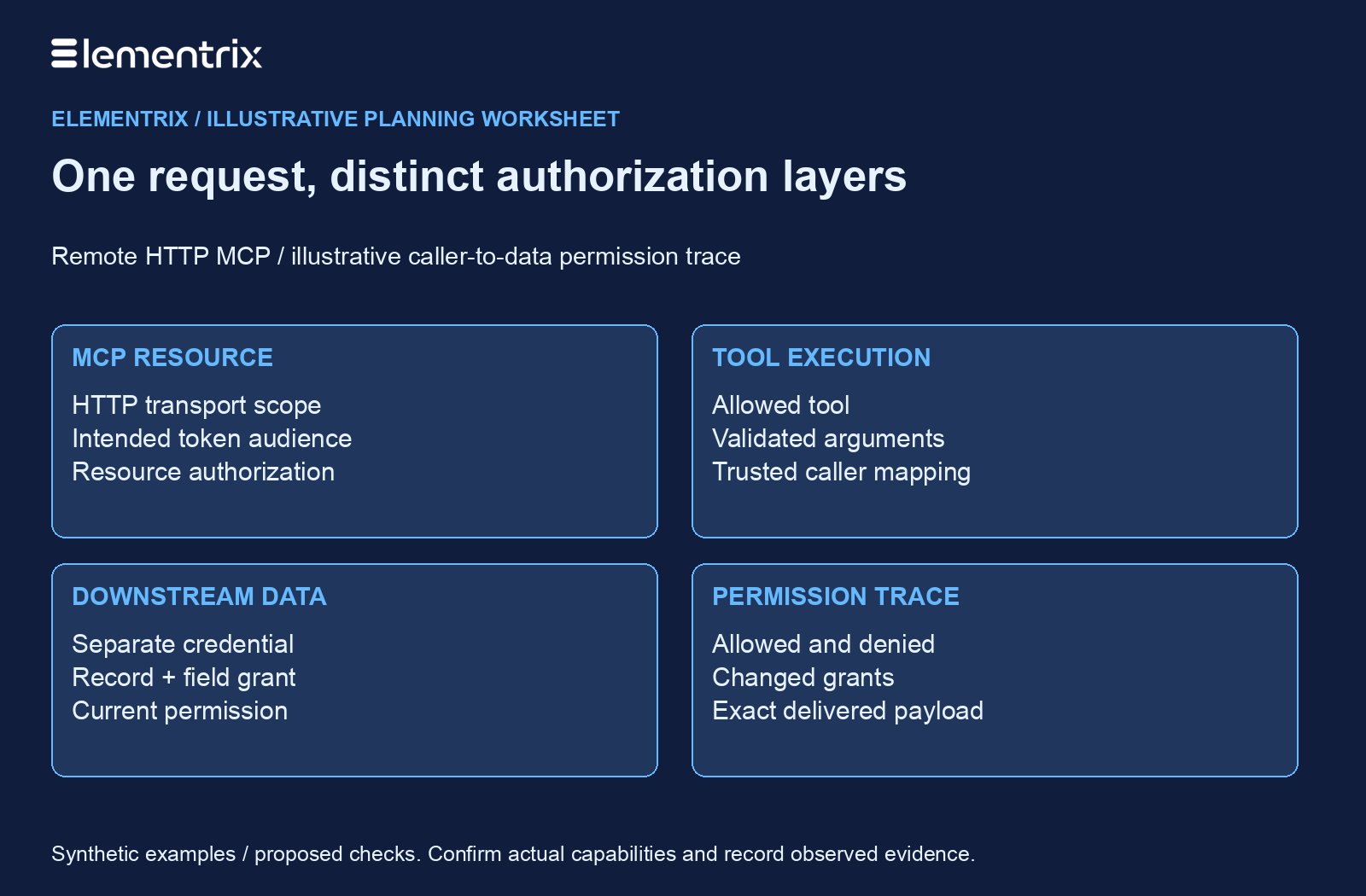
State the transport and specification scope
This guide discusses a remote MCP server using HTTP and the official authorization specification dated 2026-07-28. Its authorization flow concerns HTTP-based transports. Local stdio integrations have a different credential boundary and should not be treated as the same OAuth exchange. Verify the version and transport your implementation actually supports.
Keep two questions on the review sheet: may this client call the protected MCP resource, and may the resolved consumer perform this operation on the downstream data? A successful answer to the first does not supply a complete answer to the second. The separation is especially important when a server connects many users to one broadly privileged service account.
| Layer | What it establishes | What still needs a decision |
|---|---|---|
| MCP HTTP boundary | The request presents acceptable credentials for the intended MCP resource | Tool, record, field and operation permissions |
| Tool execution boundary | The caller may invoke the intended operation with validated inputs | Whether downstream scope is sufficient and current |
| Downstream API/data boundary | The resolved consumer may receive a particular representation | How the host and recipients handle delivered data |
| Output and evidence boundary | The system records or displays approved information appropriately | Retention, copying and later use outside that request |
Bind each credential to its intended resource
The MCP specification requires validation of tokens intended for the MCP server and forbids token passthrough to upstream APIs. When a server calls another protected API, use the appropriate separately obtained credential and authorization relationship. Do not forward an inbound token merely because it exists.
Document the identity mapping: application, delegated person if applicable, downstream account and actual grant reference. If a shared service account is used, define the trusted control that prevents it from broadening a caller’s access. An application-supplied user identifier is not adequate proof of delegation by itself. Keep credentials out of prompts, logs and evidence samples.
Trace a synthetic permission decision
| Checkpoint | Permitted case | Counterexample to test |
|---|---|---|
| MCP resource | Credential is valid for the intended server | Token for a different resource is rejected |
| Tool | read_customer_status is permitted | Administrative or arbitrary-query tool is denied |
| Downstream consumer | support-assistant maps to the approved relationship | Unmapped or forged consumer context is rejected |
| Record | Customer belongs to assigned region | Another region or tenant is denied |
| Field set | customer_id and account_status only | contact.email and credit_limit are not disclosed |
| Change | New requests resolve the current grant | Revoked or narrowed grant cannot use stale scope |
Trace the allowed case all the way to the serialized response. A tool can return a success status while its body contains an excluded property. Conversely, a downstream denial should not be “recovered” by trying a more privileged account. Make failure handling part of the interface contract so the host can distinguish insufficient permission from unavailable data.
Where tool scopes are used, specify their meaning and relationship to downstream grants. A broad scope such as a read capability is not a complete business-field contract unless your system explicitly defines and enforces that relationship. Keep the field contract versioned independently when the product schema can change.
Test permission changes across both layers
- Use a valid MCP credential with insufficient downstream permission and verify a safe result.
- Use a wrong-resource or invalid credential and verify rejection before protected processing.
- Try an allowed tool with excluded fields or an out-of-scope record.
- Narrow or revoke the data grant while keeping the session open; repeat the same read.
- Check warm caches, batched calls, exports and any alternate tool with access to the same product.
- Verify that error messages and evidence contain no credential or excluded record values.
Record timestamps, resolved identities, token-fixture references, tool arguments, grant revisions and actual outcomes. These are proposed test inputs; do not mark them passed until the environment has been exercised. Protect the detailed evidence according to its sensitivity.
For an intermittent failure, follow the chain in order instead of assuming the model chose a bad tool. Compare the intended server, client permissions, mapped identity, effective grant and delivered representation. Capture where those observations diverge. This makes the authorization trace useful to an operator as well as an architect.
Review the integration boundary explicitly
Use a diagram with distinct credential and permission labels at each hop. Ask which service owns each check, which attributes it trusts, how it detects changes and what it does when a required dependency fails. Assign an owner to any step that is described only as “the gateway handles it.”
This is a general architecture and verification guide. It does not assert that a particular Elementrix MCP integration, OAuth flow or delegation mechanism is available. Confirm the supported integration and the downstream permission behavior in the intended environment before relying on either.
For related implementation detail, see governed AI data access; data access control; Application-Level vs User-Level Data Access; Revoking Data Access: Grants, Tokens, Caches, and Copies; Governed MCP Data Access: An Enterprise Architecture Pattern.
Turn the authorization trace into an execution record with the AI agent permission test checklist.