
Choose a data pricing model by defining the value unit, delivery unit and buyer’s need for predictability. Subscription, usage and hybrid models allocate demand risk differently. A useful comparison shows the bill calculation, access terms and operating assumptions rather than declaring one model universally best.
Define what the buyer receives and what is measured
A buyer may value a reliable account-status answer while the delivery system counts API requests. Those are related but different units. Decide whether the commercial unit is a product entitlement, a consumer, a successful request, a returned record, a batch or another agreed measure. Define retries, errors, pagination and duplicate events before proposing a bill.
Document product scope alongside price: allowed fields and records, freshness, service expectations, permitted use, capacity, support and end conditions. A low per-request price is difficult to compare when one request returns one record and another returns a full batch. Do not equate technical connectivity with permission to resell the underlying data.
| Model | Bill structure | Potential buyer fit | Design question |
|---|---|---|---|
| Subscription | Fixed recurring price for a defined entitlement and capacity | Stable need and preference for predictable spend | What happens when scope or capacity is exceeded? |
| Usage | Measured units multiplied by an agreed rate | Variable or experimental demand | Can the buyer forecast and control usage? |
| Hybrid | Base entitlement plus included units and overage | Predictable baseline with variable growth | Are allowance and overage rules understandable? |
Calculate a transparent hypothetical monthly bill
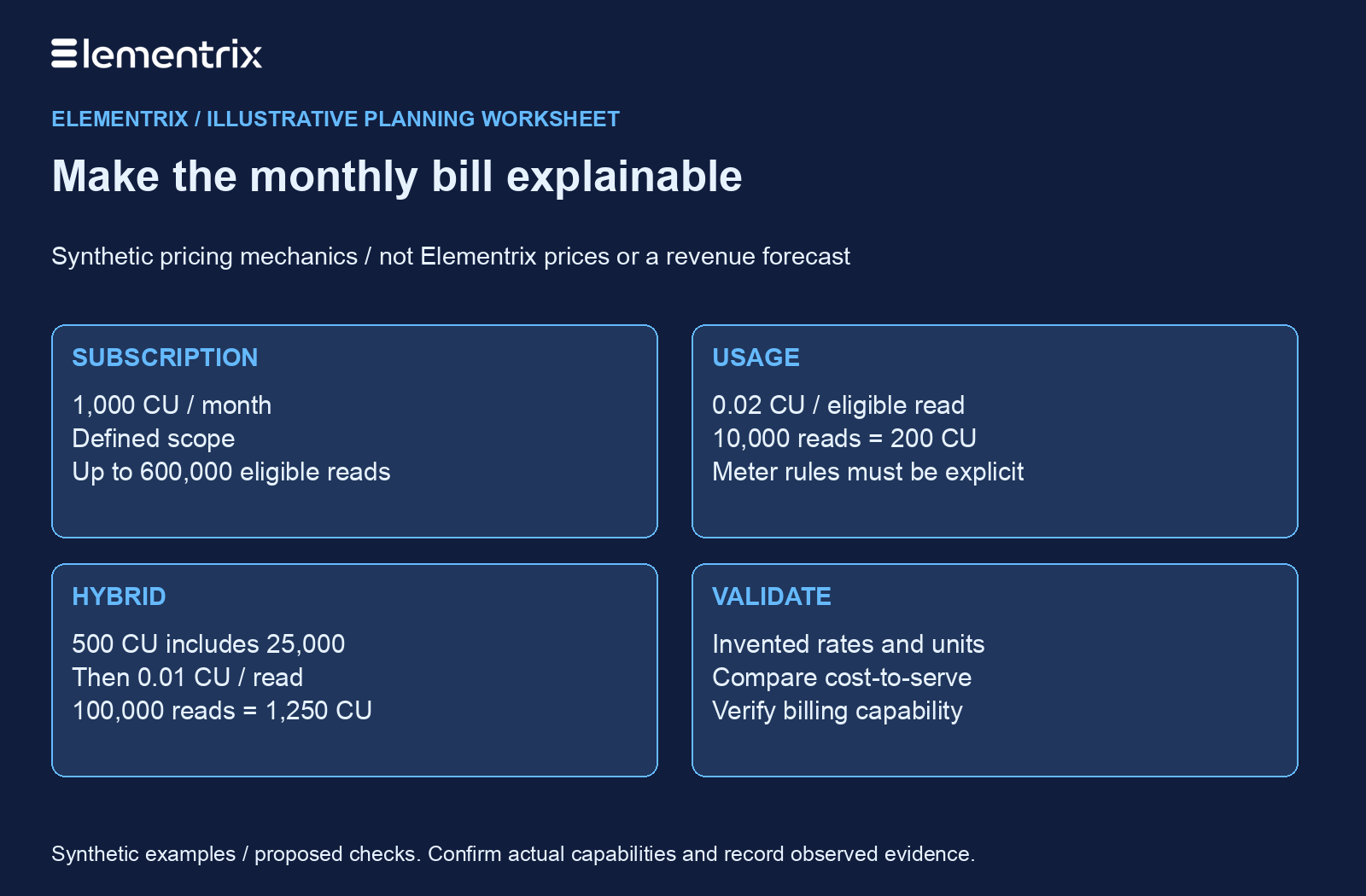
The following example uses invented currency units (CU) and a synthetic eligible-request meter. It is not Elementrix pricing, a quote or a recommended market rate. All three options cover the same agreed product scope and at most 600,000 eligible monthly reads. Taxes, discounts, support differences and other charges are excluded from this arithmetic example.
| Eligible reads | Subscription: 1,000 CU | Usage: 0.02 CU/read | Hybrid: 500 CU includes 25,000; then 0.01/read |
|---|---|---|---|
| 10,000 | 1,000 | 10,000 × 0.02 = 200 | 500 + max(0, 10,000 − 25,000) × 0.01 = 500 |
| 100,000 | 1,000 | 100,000 × 0.02 = 2,000 | 500 + 75,000 × 0.01 = 1,250 |
| 500,000 | 1,000 | 500,000 × 0.02 = 10,000 | 500 + 475,000 × 0.01 = 5,250 |
The subscription is not unlimited: the stated capacity is 600,000 eligible reads and the contract must specify behavior above that boundary. The hybrid allowance resets under an agreed monthly rule; no unused balance carries forward in this example. These choices are explicit assumptions, not universal properties of the model.
The apparent ordering changes with demand because the invented fixed and variable rates differ. That does not establish which plan is profitable or suitable. Compare the buyer’s task, expected variation and your own delivery and support cost before choosing prices. A simple bill can conceal an unsustainable service commitment if cost-to-serve is unknown.
Specify allowances, overages and controls
| Term | Question to settle | Evidence to retain |
|---|---|---|
| Eligible unit | Which successful deliveries count, and how are retries deduplicated? | Meter definition and reconciliation examples |
| Period | When does the cycle begin, reset and close? | Time zone and period boundary rules |
| Capacity | Is excess use blocked, throttled or separately agreed? | Documented behavior and buyer notification |
| Adjustment | How are errors, corrections and disputes handled? | Versioned adjustment and approval record |
| Entitlement | Which consumer, records and fields does the plan cover? | Approved relationship and contract reference |
| End of service | When does future access stop, and what about prior copies? | Closure terms and verification responsibilities |
Give buyers a way to understand their consumption before an unexpected bill arrives. Agree notifications and limits, including whether any cap is a commercial alert or a technical stop. Test period boundaries, repeated events and late-arriving records in the billing evidence process. A dashboard count and an invoice-ready meter can have different quality requirements.
Keep the billing record separate from unnecessary sensitive payloads. A unit identifier, consumer reference and qualifying-delivery evidence may be sufficient for reconciliation. Decide who can inspect details and how corrections preserve an understandable history.
Run a small commercial validation
Interview a candidate buyer about the decision the product improves, its alternative and an acceptable spending range. Present the same scope under a small number of transparent options, then ask the buyer to calculate a low- and high-demand bill. Confusion is evidence to revise the packaging, not a reason to add more pricing tiers.
During a controlled pilot, record actual eligible units, delivery and support effort, buyer feedback and permission changes. Use those observations to refine the meter and price. Do not infer demand from a published list price or convert a hypothetical bill into a revenue forecast.
Separate pricing design from platform capability
A product may have a clear commercial model while its entitlement, metering or invoicing integration still requires work. Verify which parts are supported by the intended Elementrix deployment and which remain external processes. This article does not assert the availability of a billing engine, meter, subscription system or automated entitlement bridge.
Use the pricing worksheet with the product owner, finance partner and delivery team. Agree one bounded offer whose scope and bill can be explained from the same evidence. Then validate that offer before expanding the commercial model.
For related implementation detail, see enterprise monetization strategy; marketplace operating model; Partner Data Onboarding: A Governed Access Checklist; Build vs Buy a Private Data Marketplace: A Cost Worksheet.
Discuss your scoped use case
Discuss a priced, governed data product with the Elementrix team.