
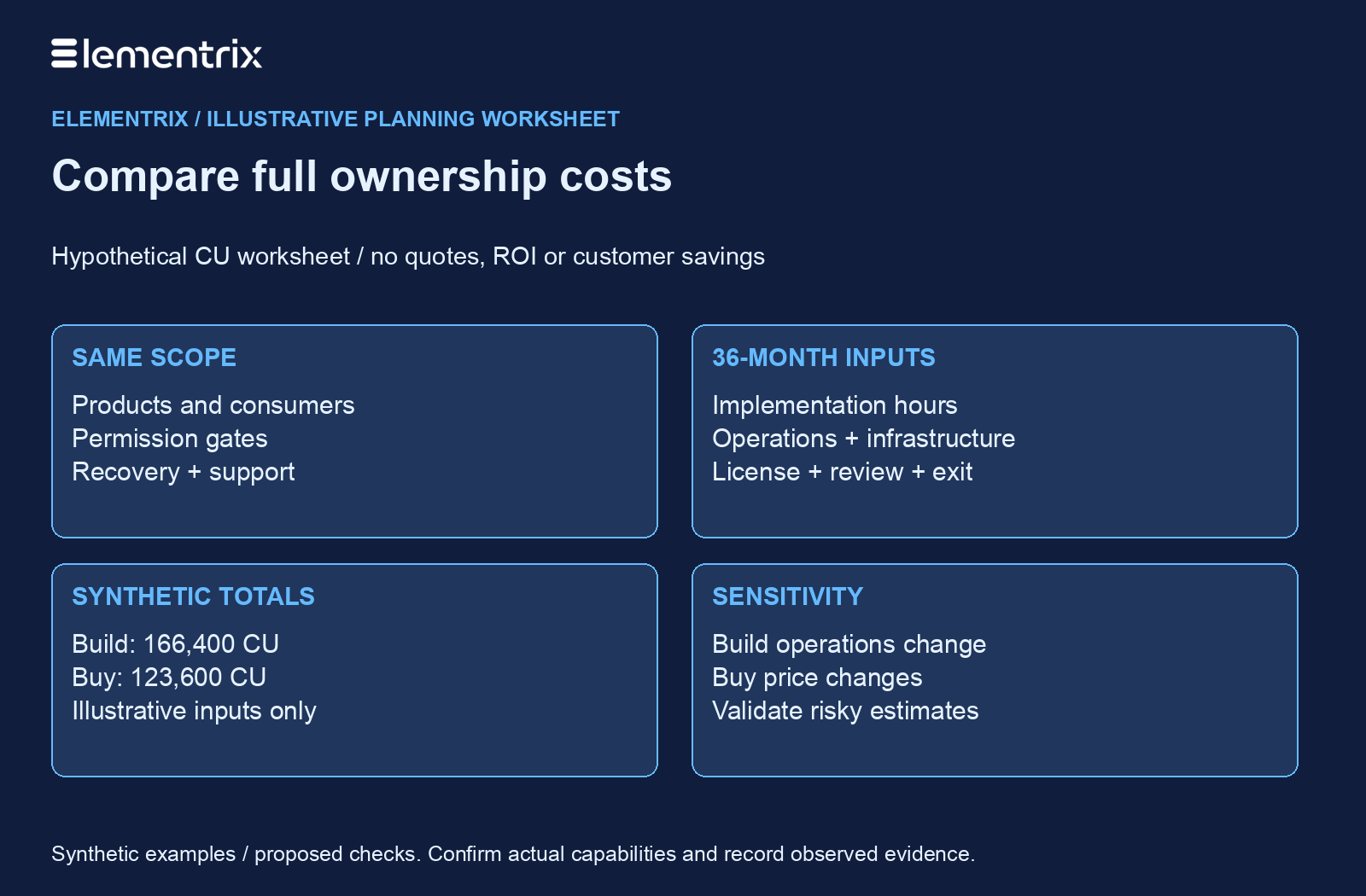
Compare building and buying a private data marketplace over the same scope, time horizon and acceptance criteria. Include implementation, integrations, operations, security review, change work and exit costs. Use sensitivity analysis to expose which assumptions drive the result rather than treating a license quote as the total cost.
Define a comparable outcome
Choose a small but complete scope: three products, one identity integration, a defined approval path, field and record permissions, one delivery interface and operating evidence. State freshness, recovery, workload and support requirements. A catalog prototype and an operated permission-enforcing service are different outcomes; their cost totals are not directly comparable.
Set the horizon, currency, labor basis and treatment of infrastructure and taxes. Keep costs that apply equally to both choices visible so they are not forgotten later. Assign an owner to each estimate and record whether it comes from a quote, an engineering estimate or an unvalidated placeholder.
Use an editable cost worksheet
| Cost component | Build assumption | Build CU | Buy assumption | Buy CU |
|---|---|---|---|---|
| Implementation/integration | 1,200 hours × 50 | 60,000 | 360 hours × 50 | 18,000 |
| Operating labor | 40 hours/month × 50 × 36 | 72,000 | 12 hours/month × 50 × 36 | 21,600 |
| Infrastructure | 400/month × 36 | 14,400 | 200/month × 36 | 7,200 |
| License/subscription | No purchased-platform fee in this example | 0 | 1,800/month × 36 | 64,800 |
| Security and change review | Illustrative allowance | 12,000 | Illustrative allowance | 6,000 |
| Exit/handover | Illustrative allowance | 8,000 | Illustrative allowance | 6,000 |
| Total | Sum of the listed inputs | 166,400 | Sum of the listed inputs | 123,600 |
These invented inputs demonstrate the calculation, not a typical market rate, vendor quote, customer saving or promised return. The example excludes financing, taxes, discounting and revenue effects. Add any component your decision requires, including commercial minimums, capacity tiers and professional services. Avoid comparing totals until missing items have owners.
Implementation includes configuration and integration work, not only coding the first interface. Operating labor includes support, access reviews, upgrades, permission regressions and product changes. Do not charge the same staff effort to both an integration line and an operations line without explaining the overlap.
Separate first release from sustained ownership
For a build, estimate who will maintain source adapters, identity mappings, field rules, schema changes, evidence storage, backup procedures and consumer documentation after the original team moves on. For a buy, estimate configuration, integration ownership, vendor upgrades, custom extensions and support coordination. A purchased component still needs an accountable service owner.
Ask which requirements would require custom work in either option. A capability that is unverified should appear as an estimate gap and an acceptance risk, not as a free feature. Keep the technical buyer scorecard separate from the cost model, then connect each critical requirement to its funded work item.
Test the assumptions that change the conclusion
| Scenario | Build total CU | Buy total CU | Interpretation |
|---|---|---|---|
| Base assumptions | 166,400 | 123,600 | Arithmetic for the stated example only |
| Build operations fall to 20 hours/month | 130,400 | 123,600 | Build operating estimate is a major driver |
| Buy license increases by 70% | 166,400 | 168,960 | Commercial price sensitivity can reverse the ordering |
In the second row, build operating labor becomes 20 × 50 × 36 = 36,000, reducing its total by 36,000. In the third row, the buy license line becomes 64,800 × 1.70 = 110,160, adding 45,360 to the base buy total. All other inputs remain unchanged in each independent scenario.
Replace these scenarios with plausible low, base and high estimates supplied by your own team and quotes. Include demand growth, a harder source integration, support coverage and a major upgrade where relevant. Do not combine the best build case with the worst buy case and present that as a neutral baseline.
Record risk and reversibility alongside cost
- Who owns permission correctness and can fix a production defect?
- Which specialist skills are required and available for the full horizon?
- Which dependencies or commercial terms can change the model?
- How will metadata, evidence and configuration be exported at exit?
- Which acceptance failures would make either option unsuitable regardless of price?
- What is the smallest proof of value that can replace the riskiest estimate with evidence?
The lowest modelled cost can still be a poor fit if a critical requirement is unverified or operational ownership is unclear. Conversely, an expensive bespoke capability may be justified by a requirement that a purchased option cannot meet. Keep the requirement, evidence and cost connected so reviewers can assess that tradeoff.
Use the worksheet in a scoped technical and commercial discussion. Ask the Elementrix team for supported capabilities and an actual quote for your intended scope; replace every placeholder before relying on the model. This article makes no product-price, ROI, payback or savings claim.
For related implementation detail, see internal marketplace launch guide; governance solution-design context; Private Data Marketplace Deployment: On-Premises vs Private Cloud; Private Data Marketplace Evaluation Checklist for Buyers.
Discuss your scoped use case
Validate your assumptions in a scoped technical and commercial discussion.