
Evaluate a private data marketplace with representative products, a real consumer journey and evidence-based acceptance tests. A feature checklist is useful only when it shows what was demonstrated, what requires integration and what remains unverified. Apply critical permission and recovery gates before comparing weighted scores.
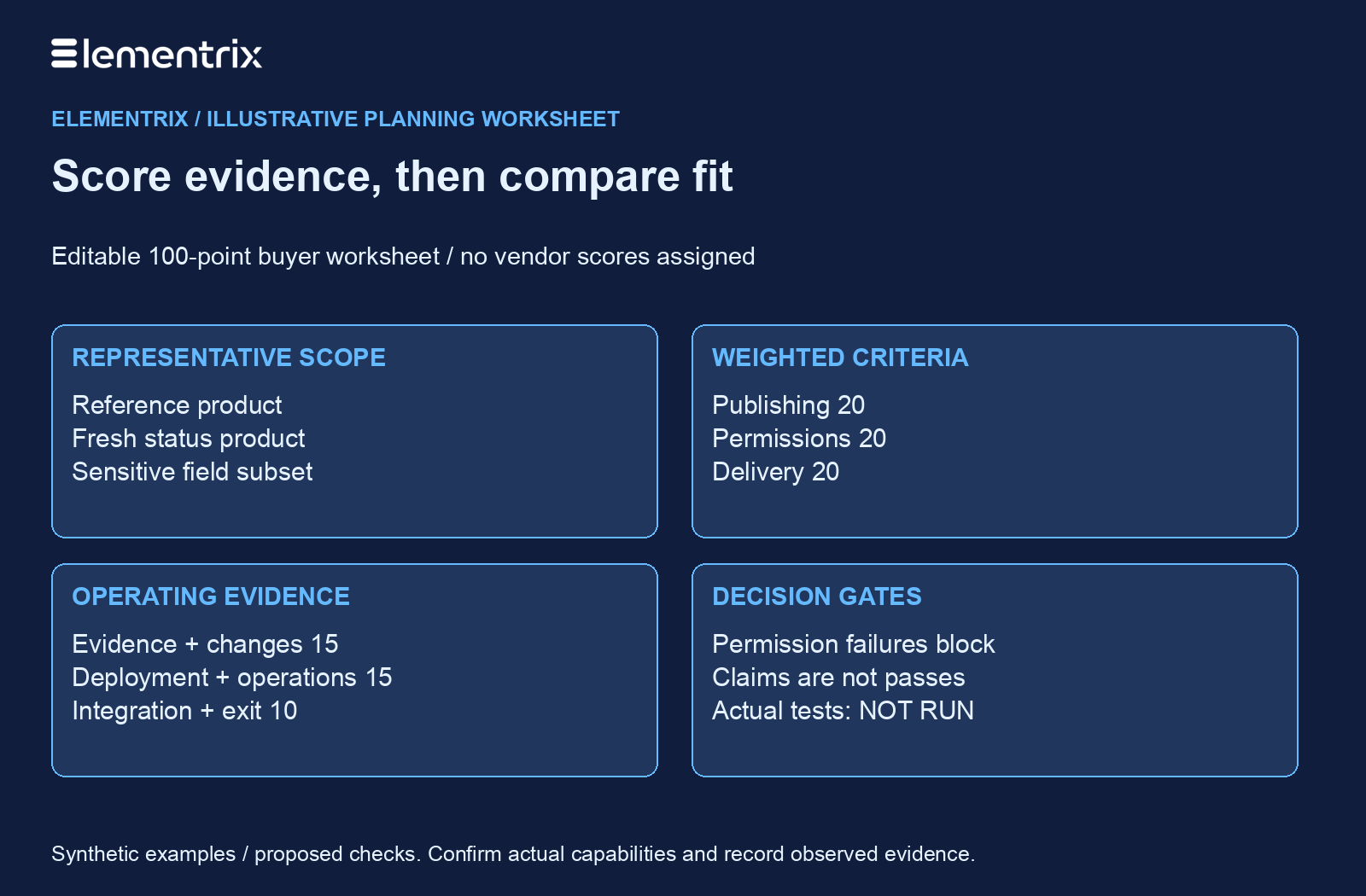
Start from consumers and three representative products
Choose a consumer who can state a real task and recognize a useful response. Select products that expose different requirements: a stable reference list, a frequently refreshed status product and a sensitive product with a narrowed field set. Use approved or synthetic data in the proof of value. Avoid using three nearly identical products that exercise only the easiest integration.
Agree the scope before a demonstration: source interfaces, identity provider, deployment, product versions, permission boundaries, workload and completion criteria. A working vendor example does not establish that your intended source or environment is supported. Record the evidence for each dependency.
Separate mandatory gates from weighted preferences
| Criterion | Illustrative weight | Evidence needed | Acceptance test |
|---|---|---|---|
| Product publishing and discovery | 20 | Owned product definition and consumer documentation | Consumer finds the correct version and owner |
| Approval and permissions | 20 | Decision record and effective field grant | Request five fields, approve three, verify the response |
| Delivery and freshness | 20 | Interface contract and meaningful timestamps | Exercise representative load and stale-data behavior |
| Evidence and changes | 15 | Correlated decisions and version records | Reconstruct a request and change a grant |
| Deployment and operations | 15 | Prerequisites, responsibilities and recovery plan | Restore and upgrade in the intended environment |
| Integration and exit | 10 | Effort estimate, export and handover procedure | Move agreed metadata/evidence and close a consumer |
These weights total 100. Replace them with priorities agreed by your stakeholders. Mandatory requirements—such as preventing cross-tenant disclosure—remain gates even if another feature receives a high score. A weighted total must not average away a critical failure.
Use a consistent rating scale: 0 means not demonstrated; 1 means a documented claim; 2 means partial evidence; 3 means the agreed acceptance test passed; 4 means that test passed with the required operating evidence. A claim is not a pass. For a weight of 20 and a rating of 3, the illustrative contribution is 20 × 3 ÷ 4 = 15. Record who assigned each rating and which artifact supports it.
Walk the complete consumer journey
Ask the product owner to publish the definition, classification, schema, freshness expectation and access contact. Then let the selected consumer discover it, explain the task, request a narrower scope and follow the approval outcome through to a usable interface. Keep the requested, approved and effective scope separate.
Run a negative case as well as the happy path. Request an excluded property, another record and a prohibited operation. Check the actual payload and error behavior. A polished approval screen cannot establish that the serving path enforces the decision. Repeat after changing the grant or product version.
| Test | Pass criterion agreed before execution | Actual evidence |
|---|---|---|
| Find and understand | Consumer identifies the intended product and its meaning | NOT RUN |
| Approve and consume | Delivered representation matches the approved scope | NOT RUN |
| Deny excess access | Excluded fields and records are not disclosed | NOT RUN |
| Handle stale data | Behavior matches the product’s documented age budget | NOT RUN |
| Change and revoke | Subsequent requests reflect the agreed permission-change boundary | NOT RUN |
| Operate and recover | Named team can restore and support the scoped service | NOT RUN |
Include integration effort and operating ownership
List every integration as an owned work item: source connection, identity mapping, approval routing, field enforcement, evidence collection, monitoring and support handover. Mark which pieces are standard, configured, custom or unknown. Ask for prerequisites and an estimate based on the selected scope rather than counting a connector name as completed work.
Review access to production, release ownership, upgrade regression checks, backup protection, recovery objectives and incident handling. Separate a vendor responsibility from a customer responsibility. A required capability that depends on another service remains a dependency even when that service is familiar to your organization.
Make the final decision reviewable
- Keep the scorecard version, editable weights and rating definitions.
- Attach evidence paths, environment versions, identities and dates to each result.
- Record limitations and manual steps alongside successful observations.
- Assign owners and dates to unresolved gaps; retest the same acceptance case.
- Compare commercial quotes and operating estimates against the same scope.
- Agree the exit and data-handling plan before treating the evaluation as complete.
Use the scorecard to compare demonstrated fit, integration burden and ownership. Do not turn it into an unsupported ranking of vendors or a procurement shortcut. If a critical gate remains unverified, say so directly even when a weighted total looks attractive.
The worksheet is an original evaluation proposal. It does not assign scores to Elementrix or claim that any capability, deployment mode or acceptance test has already been demonstrated. Use it to structure a supported demonstration with your actual owners and representative products.
For related implementation detail, see internal marketplace launch guide; governance-tool evaluation context; Data Catalog vs Data Marketplace: A Buyer’s Comparison; Data Serving Layer vs API Gateway: Roles and Boundaries; Private Data Marketplace Deployment: On-Premises vs Private Cloud.
Model the implementation and operating estimates with the build-versus-buy cost worksheet, keeping its assumptions separate from the acceptance score.