
Choose a private data marketplace deployment by mapping data, network, identity and operating responsibilities—not by the hosting label alone. On-premises infrastructure and private-cloud environments can both require substantial integration, recovery and support work. Compare the same workload and evidence requirements in each.
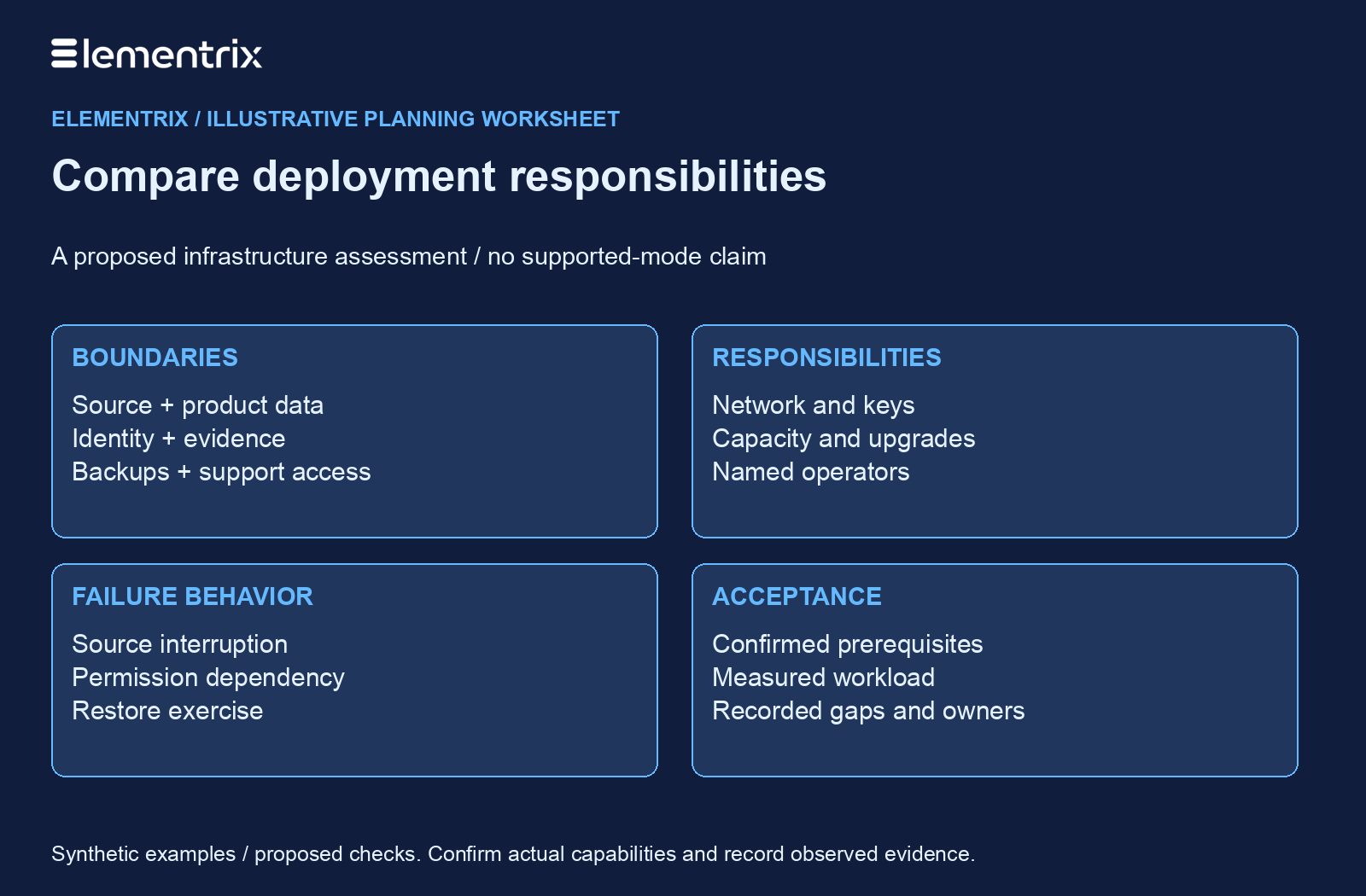
Define the deployment boundary first
Draw the systems that hold source data, product representations, policy state, credentials, evidence, backups and management access. Mark every connection that crosses an organizational or network boundary. A marketplace can expose a private application while depending on external identity, monitoring or support services; include those dependencies in the assessment.
On-premises describes a location and operating arrangement. Private cloud describes an environment dedicated to an organization and does not, by itself, establish its location. NIST’s cloud-computing definition distinguishes deployment models. Use the actual contract and architecture to determine isolation, access and operational ownership.
| Area | On-premises question | Private-cloud question |
|---|---|---|
| Network | Who provides routing, DNS, TLS and firewall changes? | Who owns private connectivity, network policy and egress? |
| Compute and storage | Who sizes, patches and replaces capacity? | Who configures capacity, quotas, storage and platform services? |
| Identity and keys | How do enterprise identity and key controls integrate? | Which identities, secret stores and key administrators are trusted? |
| Upgrades | Who schedules, tests and rolls back a release? | Which provider and application upgrades require coordination? |
| Backup and recovery | Where are protected copies and restoration procedures? | Which services are covered, and who performs the restore test? |
| Support access | How is temporary administrative access approved? | How are provider and vendor access scoped and recorded? |
Assess the real workload and its dependencies
Use one representative consumer and three products: a small reference product, a frequently refreshed status product and a product with sensitive fields. Define expected payload size, request pattern, concurrency, refresh behavior and permission checks. Keep these as planning inputs until measured. An average request rate can conceal a burst during a source outage or business event.
Map control and data paths separately. A data read may remain available while the identity service or policy source is unavailable, but that behavior must be designed and tested. Decide what can continue safely with cached state, for how long and under which conditions. A private network does not remove the need for application and field authorization.
Compare residency, availability and operating effort
| Requirement | Evidence needed | Owner |
|---|---|---|
| Data location | Locations of primary data, replicas, logs, exports and backups | Data and infrastructure owners |
| Recovery | Agreed recovery objectives plus a documented restore exercise | Service owner |
| Access | Identity federation, administrator access and key-handling design | Security and identity owners |
| Connectivity | Source, consumer and management paths with failure behavior | Network owner |
| Operating cost | Capacity, connectivity, support, licenses and staff estimates | Finance and service owners |
| Change work | Upgrade, rollback and integration regression procedure | Platform owner |
Distinguish a required location from a jurisdiction-specific legal conclusion. Confirm any applicable residency requirement through the appropriate authoritative process. Do not assume that a region name alone covers support access, telemetry and backups. Record exceptions and decisions in the same architecture file.
For availability, define the service boundary that the business actually needs. Backing up a database is not evidence that the marketplace, permission state and credentials can be restored together. Measure a representative recovery and note dependencies that remain outside the test.
Work through a synthetic infrastructure assessment
A fictional operations team wants regional applications to read Customer Status while keeping source-system traffic controlled. Its candidate environment has a private consumer network, enterprise identity and an existing recovery site. The team has not yet confirmed vendor prerequisites or the availability of either deployment mode.
Before selecting a location, it records source connectivity, product refresh ownership, required identities and evidence storage. It tests one allowed and one denied read, interrupts a refresh dependency and restores a protected environment from backup. The proposed acceptance record includes actual timestamps, versions and unresolved gaps. These are planned checks, not completed test results.
- List software and infrastructure prerequisites confirmed by the vendor.
- Identify every externally managed dependency and its failure behavior.
- Measure a representative read and refresh workload; retain the test configuration.
- Demonstrate permission enforcement on warm and cold paths.
- Restore the application, product and permission state together.
- Agree upgrade ownership, support access, capacity triggers and exit arrangements.
Use the deployment demonstration to close decisions
Ask the implementation team to show the intended environment rather than a generic diagram. Walk through provisioning, source connection, identity integration, one consumer request, evidence collection, backup restoration and an upgrade rollback. For each step, record whether it is available, requires integration or remains unverified.
This comparison is a planning framework. It does not assert that Elementrix currently supports a particular on-premises or private-cloud configuration, prerequisite set or recovery target. Confirm the supported modes and operating responsibilities for your intended environment before making a commitment.
For related implementation detail, see internal marketplace launch guide; system-decoupling architecture; Data Serving Layer vs API Gateway: Roles and Boundaries.
Use the buyer evaluation scorecard to compare demonstrated fit, and the build-versus-buy cost worksheet to model ownership effort.
Discuss your scoped use case
Book an infrastructure assessment for your intended environment.