
RBAC and ABAC describe how an access decision is made; field-level access describes the granularity of the result. You can use roles, attributes or both to decide which properties a consumer may read or change. Choosing one policy model does not remove the need to enforce the resulting field boundary.
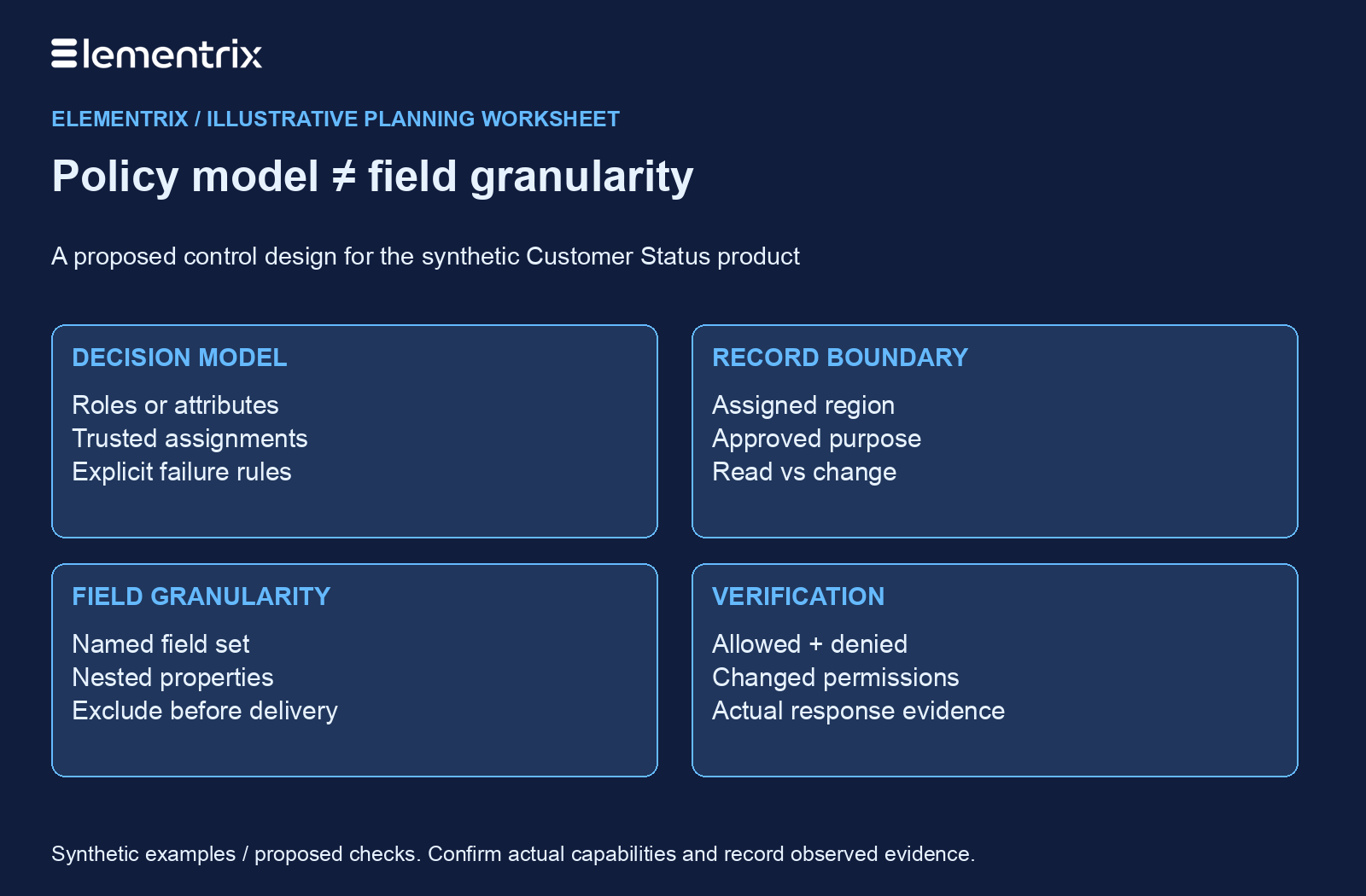
Define the decision model before choosing its granularity
Start with a concrete request: a regional support application wants a customer’s account status. Identify the authenticated application, any delegated employee, the record, the operation and the fields requested. Then decide which facts are authoritative for each part of the decision. A role name by itself does not describe a record boundary or a response schema.
In role-based access control, permissions are associated with roles and subjects receive relevant role assignments. Attribute-based access control evaluates policy against attributes of the subject, object, operation and sometimes environment. NIST SP 800-162 provides the ABAC definition and implementation considerations. A role can also be an attribute evaluated by a broader policy.
| Question | Role-based example | Attribute-based example |
|---|---|---|
| Who may attempt the operation? | Assigned support-reader role | Consumer type and approved purpose match policy |
| Which records are eligible? | Role combined with a regional assignment | Record region matches trusted consumer region |
| Which fields may be returned? | A role maps to a named field set | Attributes select a permitted representation |
| What changes the outcome? | Role assignment or permission mapping changes | An authoritative attribute or policy revision changes |
Combine a decision with a field contract
Write the allowed field set explicitly for each operation. Reading a property and changing it are different permissions. A response serializer, query projection or equivalent trusted serving control must apply the read decision before returning data. A hidden column in a user interface does not constrain a direct API response.
Keep subject and resource attributes under trusted control. A caller should not be able to grant itself the north-region attribute through request JSON. Define what happens when an attribute is missing, stale or contradictory. Prefer a documented denial or other restricted behavior to silently broadening the response. Validate this at the actual enforcement point rather than relying on a policy-editor screenshot.
Work through three synthetic consumers
| Consumer | Decision inputs | Allowed response | Deliberate exclusion |
|---|---|---|---|
| Employee console | support-reader role; assigned region north | customer_id, account_status, service_region | contact.email and credit_limit |
| Partner router | partner organization active; routing purpose; assigned records | customer_id, account_status, service_region | Contact and financial properties |
| Billing application | service identity; billing grant; product version | customer_id, account_status, credit_limit | contact.email and unrelated records |
For the employee console, a role is an understandable starting point when responsibilities are stable. Add a separately maintained record assignment rather than creating a new role for every customer. For the partner, organizational status and contract conditions may be useful attributes, but the delivery service still needs a precise field set. For the billing application, verify the application grant even when an employee has a broader role.
These examples are architecture choices, not a claim that Elementrix implements a particular RBAC or ABAC engine. Confirm the policy constructs and enforcement behavior supported by the deployment you are evaluating. The important acceptance evidence is the actual allowed and excluded response behavior.
Choose a model your team can maintain
| Decision factor | Question to answer | Evidence to collect |
|---|---|---|
| Role stability | Are job responsibilities stable enough for a manageable role catalog? | Role owner, assignment process and review sample |
| Attribute quality | Who owns each attribute and its freshness? | Trusted source, update path and failure rule |
| Explainability | Can an operator explain a denial without guessing? | Resolved inputs, policy version and reason reference |
| Change management | How do policy and field-set changes reach every route? | Versioned change record and regression checks |
| Operational cost | Can the serving path evaluate the policy within its requirements? | Measured behavior under a representative workload |
A small role catalog with well-defined field sets can be easier to operate than an ambitious attribute policy fed by unreliable sources. Conversely, replicating every regional or partner condition as a separate role can become hard to review. Compare the maintenance burden using your actual consumers; do not assume that a more expressive model is automatically more suitable.
Verify the resulting permissions
- Test one approved field and one excluded field through the same endpoint and identity.
- Test a different record, nested property and write operation separately.
- Change a role, attribute or grant and record when the delivery path reflects the new decision.
- Capture the policy and field-set revision, request identifier and actual result; keep sensitive values out of routine evidence.
Record disagreements between the policy model and the delivered representation as defects with an accountable owner. Repeat the test after changes to schemas, caches and alternative export routes. This makes the comparison an operating decision rather than a terminology exercise.
For related implementation detail, see field-level security controls; data access control; Application-Level vs User-Level Data Access; How to Test Field-Level API Permissions.
Discuss your scoped use case
Discuss the policy model and field granularity your consumers need.