
Data product ownership means naming who can make decisions about a product’s purpose, use and service expectations, and who does the work that keeps those decisions effective. A team name in a catalog is a starting point. An operating model also needs accepted responsibilities for publishing, access, quality, incidents and retirement.
This guide provides a copyable RACI template for one data product. It is a recommended starting point, not a universal organization chart. Adapt it to your decision rights, separation-of-duty requirements and existing incident process. The worked customer-status product and role assignments below are synthetic.
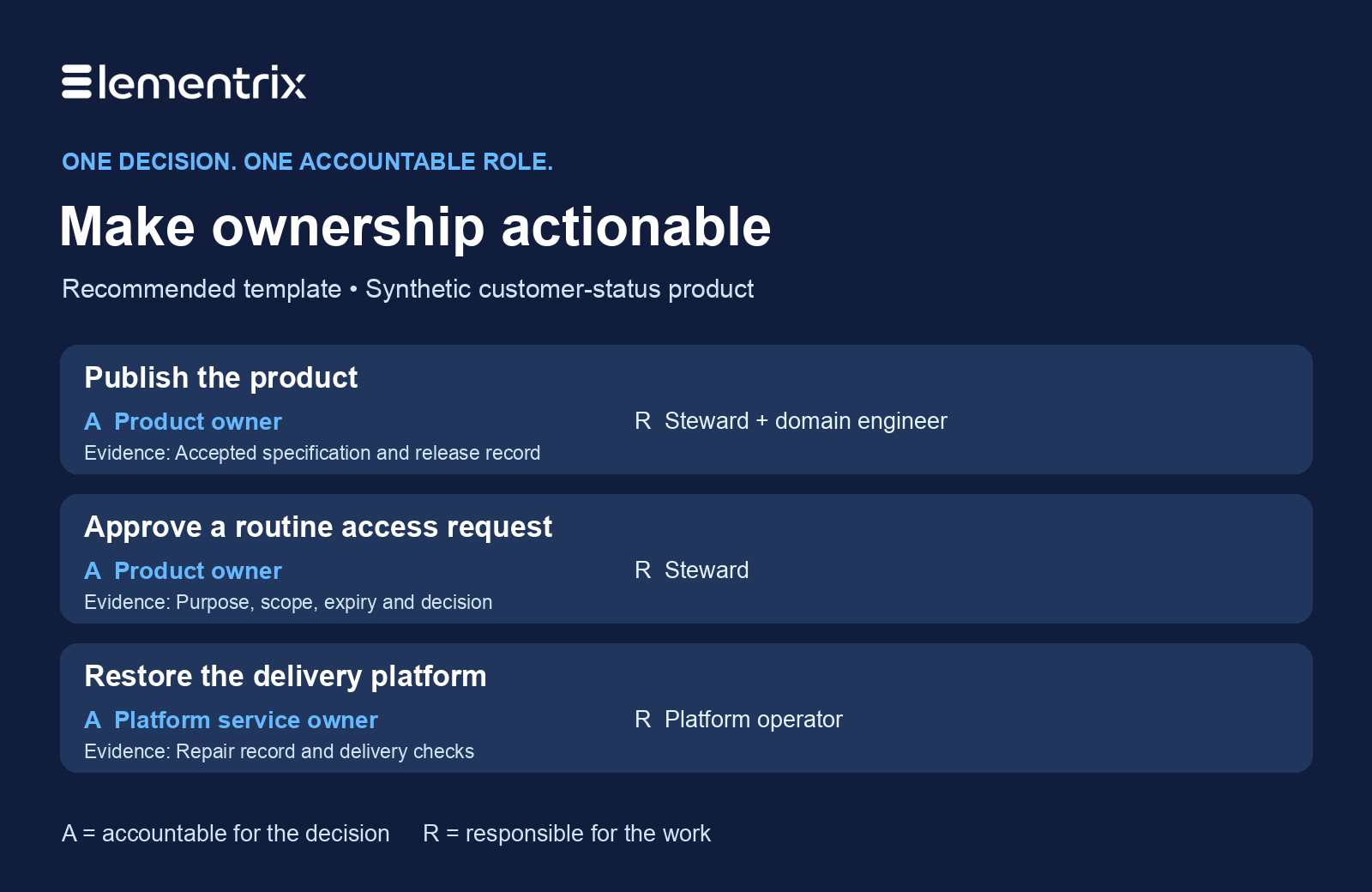
Distinguish the owner, steward and platform operator
The accountable owner needs authority to make trade-offs for the product and a route to obtain resources. The steward coordinates its day-to-day meaning and governance. Engineers and platform operators implement and run the technical components. Putting all of these responsibilities under “the data team” hides the handoffs that need to work.
For the broader definition and components, start with what a data product includes. Here, the task is to assign decisions for a particular product.
| Role | Primary responsibility in this template | Boundary to record |
|---|---|---|
| Product owner | Accepts the product’s purpose, consumer commitments, release decisions and routine access decisions within delegated authority. | May need a separate domain data owner’s authorization for source data or a new use. |
| Data steward | Maintains definitions, coordinates request evidence, triages quality issues and keeps ownership records current. | Does not gain approval authority merely by maintaining metadata. |
| Domain engineer | Builds transformations, implements approved product changes and investigates product-specific faults. | Technical ability to change a field does not authorize a new business use. |
| Platform service owner/operator | Owns platform restoration decisions and executes shared delivery, credential and observability operations. | Platform operation does not determine whether a consumer’s purpose is acceptable. |
| Governance delegate | Advises on policies and decides exceptions only within documented delegated authority. | Split mandatory specialist decisions into separate rows when security, privacy or legal approval is required. |
| Consumer application owner | States the consuming task, owns the application integration and checks whether delivered data is usable for that task. | Cannot expand access beyond the approved purpose, fields or records. |
Data owner and product owner may be different people
A domain data owner may have authority over the source data, while a product owner manages a particular consumer-facing product built from it. Record both if those authorities differ. For example, the product owner may accept a release while the domain owner separately authorizes reuse of a sensitive source field. Do not resolve this distinction by assigning two accountable roles to an ambiguous “approve everything” row.
Zhamak Dehghani’s original data mesh principles place domain ownership and data as a product alongside shared platform and governance responsibilities. Those principles provide context; the specific RACI below is our proposed operating template, not a matrix prescribed by that article.
Map decisions before assigning the letters
Start with one product and list observable decisions. Replace broad tasks such as “manage quality” with “accept the quality rule,” “triage a failed check” and “decide whether consumers can continue.” They may have different accountable roles.
Use these meanings consistently:
- R — Responsible: performs the work and produces the evidence. Where several roles are responsible, name a lead for the handoff.
- A — Accountable: accepts the outcome or makes the specific decision. This template uses exactly one A per row; the same role may also do the work, shown as A/R.
- C — Consulted: supplies input before the decision. Record mandatory approvals separately rather than hiding them in C.
- I — Informed: receives the decision or resulting change.
- —: no routine participation in that row; it does not remove other policy obligations.
Pair the matrix with an evidence register: decision, named person or accepted team role, delegate, authority boundary, artifact, escalation contact and review date. A RACI describes responsibility; it does not configure permissions or enforce access.
A copyable RACI for one product’s lifecycle
Synthetic example: the Customer Status product serves an approved internal service-routing application. The initial response contains account ID, status and service region. The proposed roles are PO (product owner), DS (data steward), DE (domain engineer), PS (platform service owner/operator), GD (governance delegate) and CO (consumer application owner).
In an organization where the platform service owner and operator are different roles, split PS into separate columns. Keep the service owner accountable for the platform restoration decision and the operator responsible for execution.
| Decision or activity | PO | DS | DE | PS | GD | CO |
|---|---|---|---|---|---|---|
| Accept purpose, consumers and initial scope | A | R | C | C | C | C |
| Maintain definitions and ownership metadata | A | R | C | I | C | C |
| Accept quality and freshness expectations | A | R | C | C | C | C |
| Accept the product release for publication | A | R | R | C | C | I |
| Decide a routine access request within delegated policy | A | R | C | C | C | C |
| Decide a policy exception within delegated authority | R | R | C | C | A | C |
| Apply and verify the approved delivery grant | A | C | R | R | I | C |
| Accept the consuming application integration | C | C | C | C | I | A/R |
| Triage a failed product quality check | A | R | R | C | I | I |
| Decide restrictions and notify affected consumers | A | R | C | C | C | I |
| Restore the shared delivery platform | C | I | R | A/R | I | I |
| Accept a schema change and migration plan | A | R | R | C | C | C |
| Review continued access and initiate revocation | A | R | R | R | C | C |
| Approve retirement and confirm consumer transition | A | R | R | C | C | R |
For release and grant-verification rows, DS leads evidence collection and DE leads technical implementation; PS performs the platform steps. Name those leads in your local register. If the actual grant is controlled by a separate IAM service, add its accepted role rather than assuming the product team can change it.
Use the data product specification template to capture the product’s purpose and commitments. Use the access approval workflow guide for request routing and partial approvals. The RACI assigns responsibility for those artifacts; it does not replace them.
Work one request through the matrix
Suppose the synthetic routing application requests account ID, status, service region and contact email. The steward documents why each field is requested. The product owner approves the first three within the agreed routing purpose and excludes email because this task does not require contact. If a new use or policy exception is needed, the exception follows its separate decision path.
The engineer and platform operator then implement the approved scope. Their evidence must show that the actual response respects the decision, including record boundaries and excluded fields. The consumer application owner verifies the integration serves its routing task. A recorded approval alone does not prove technical enforcement or application correctness.
| Handoff | Minimum reviewable evidence |
|---|---|
| Request to decision | Application identity, accountable consumer owner, purpose, requested fields, permitted records, duration and decision authority. |
| Decision to implementation | Approved and excluded scope, decision reference, implementation owner, verification method and result. |
| Implementation to consumption | Consumer acceptance, remaining limitations, support contact and next review date. |
| Review to closure | Continued need or revocation decision, execution evidence and checks of effective access. Revocation does not recall already downloaded copies. |
Escalate when ownership is unclear
Do not send an unresolved access decision to whichever engineer can execute it. Route the ownership gap to the designated domain sponsor or governance authority. Record the disputed decision, product and affected consumers, competing role claims, interim restrictions, named escalation owner and the locally agreed deadline.
- No accepted owner: ask the domain sponsor to appoint an accountable role and confirm its authority. Keep new discretionary releases and grants on hold until an authorized decision can be made.
- Two teams claim authority: separate the decisions. Source-data reuse, product release and platform restoration can have different accountable roles.
- Owner unavailable: use a documented delegate with a defined scope and duration. Do not infer delegation from an email forwarding rule.
- Incident underway: follow the established incident process and emergency authority. Capture containment and restoration decisions, then reconcile product responsibilities afterward.
Cross-domain standards and exceptions belong in the wider data mesh governance model. This product-level matrix should reference that authority instead of creating a competing policy.
Review quarterly and when responsibilities change
A quarterly review is a practical starting cadence for this template, not a universal requirement. Review sooner after a reorganization, owner departure, new sensitive source, consumer change, major incident or product retirement decision.
- Confirm each accountable role and delegate still accepts the responsibility and has the authority to act.
- Walk a recent release, request and incident through the matrix. Find handoffs that relied on an unrecorded person.
- Check the actual product, support and identity records against the register. Updating a RACI does not transfer credentials, grants or on-call duties.
- On reassignment, retain the outgoing owner, incoming acceptance, effective date, open decisions and next review. Revalidate approval routing and escalation contacts.
Start with one product and use its real handoffs to refine the matrix. A completed template should make the next decision easier to route and its evidence easier to find.
Map your current owner-to-approval workflow
Bring one product, one access request and your current ownership record. Request an Elementrix demo to discuss the owner-to-approval workflow and the controls your team needs to verify.