
A data freshness SLA should name the consumer, the timestamp being measured, the point where it is measured, the acceptable age, the reporting window and the action when the requirement is missed. “Updated every ten minutes” leaves too much open: a pipeline may run successfully while an application still receives an older product version.
This guide supplies a copyable freshness agreement and a worked timestamp example. The values, product and outcomes are synthetic. Treat the proposed targets as a starting design for discussion, not an Elementrix service commitment or evidence of a measured deployment.
Separate a freshness target from a contractual SLA
Use SLI for the measured indicator, SLO for its target and SLA for an agreement with defined consequences. Google’s service-level objectives chapter explains this distinction. An internal worksheet labeled “SLA” does not by itself establish a contractual promise.
The template below is a proposed operating agreement. Before offering it as a formal SLA, align the measurement, service scope, exclusions, responsibilities and consequences with the people authorized to make that commitment. A monitoring threshold and a contractual commitment are separate decisions.
Define freshness with event, ingestion and serving timestamps
Begin with the consumer’s task and the data version it actually receives. A timestamp can describe an event, a load, a transformation or a response; those are different facts.
| Timestamp | What it represents | What it does not establish alone |
|---|---|---|
| Event time | When the source says the business event occurred. | When it arrived, or whether all expected events arrived. |
| Ingestion time | When the receiving pipeline accepted that event or batch. | Whether downstream transformations or delivery completed. |
| Product-ready time | When a particular validated product version became available to serve. | How recent the source state represented in that version is. |
| Serving time | When the consumer received the observed response. | The age or completeness of its contents. |
| Source coverage cutoff | A documented boundary through which the delivered version is known to cover required source changes, under an agreed late-data policy. | A universal field automatically supplied by every platform. |
Apache Beam’s event-time and late-data guidance describes why arrival order and event time can differ. If you use a watermark, document its semantics and how late events change the result. Do not treat an estimated progress marker as unconditional proof that nothing is missing.
Pick a metric that fits the task
For a changing operational state, a useful proposed indicator is source_coverage_age = served_at - source_complete_through, measured on the version actually returned. This requires trustworthy coverage evidence, such as an accepted source checkpoint tied to the product version. If that evidence does not exist, label the available metric accurately rather than inventing a coverage cutoff.
For an event notification, the relevant measure may instead be delivered_at - event_at for each expected event. That measures event delivery delay. An unchanged account record can have an old business-event timestamp and still accurately represent current state; measuring its event age alone would misclassify it.
The newest timestamp in a whole table can hide stale regions or partitions. Define the critical scope and measure each required segment. Check completeness separately: one fresh row is not evidence that the rest of the expected data arrived.
A worked timestamp example
All times below are UTC on October 21, 2026. The synthetic Regional Account Status product serves a routing application. The delivered version’s accepted source checkpoint covers required changes through 08:00.
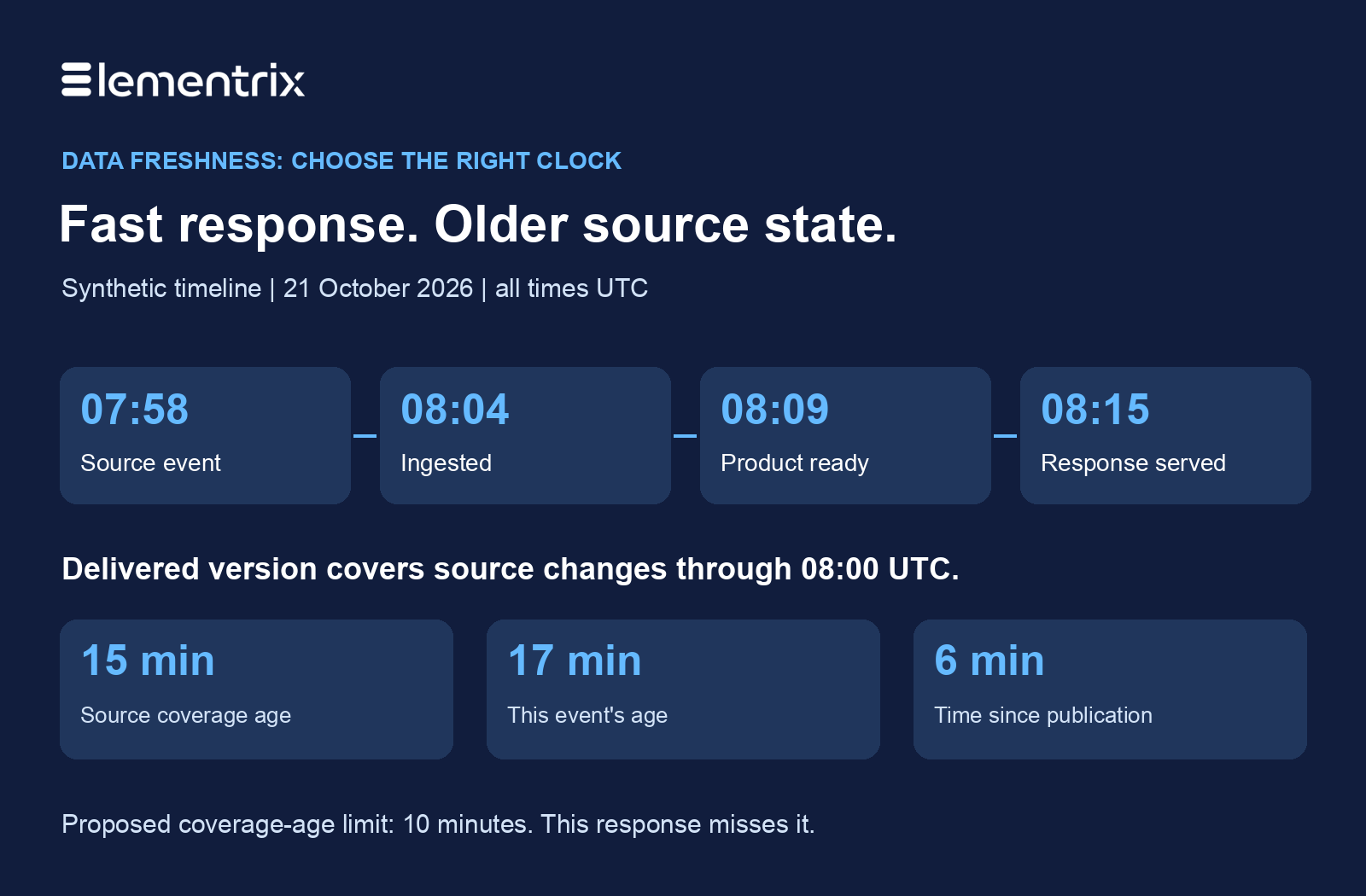
| Measurement | Calculation | Interpretation |
|---|---|---|
| Ingestion delay for this event | 08:04 − 07:58 = 6 minutes | Time between source event and pipeline receipt. |
| Product processing after receipt | 08:09 − 08:04 = 5 minutes | Time to make the product version ready after ingestion. |
| Time since product publication | 08:15 − 08:09 = 6 minutes | Age of the product-ready timestamp at observation. |
| Age of this event at serving | 08:15 − 07:58 = 17 minutes | Age of this particular source event in the response. |
| Source coverage age at serving | 08:15 − 08:00 = 15 minutes | Distance from the consumer observation to the accepted coverage cutoff. |
A proposed ten-minute coverage-age limit is missed by this response even though publication was only six minutes ago. A quick API response would not change that conclusion. If API latency is also a concern, treat it as a separate requirement; our API performance guide covers a different part of the delivery problem.
Set the target around the consumer’s decision
Ask what becomes unsafe or unusable as the information ages. A daily planning report and an automated routing decision need not have the same window. Record the business consequence before selecting a number. Do not copy a streaming target into a daily batch product simply because both use APIs.
Specify service hours and timezone, required segments, observation frequency and the tolerated miss rate. Choose monitoring frequency to detect problems early enough for the agreed response. A periodic probe measures its scheduled observations; it does not prove every response between probes was fresh. State whether your indicator is sample-based, request-based or event-based.
For the wider product record, use the data product guide and the specification template. Put the detailed freshness agreement alongside the product’s purpose, schema and ownership.
Copy this freshness agreement template
The filled values below are proposed examples, not tested performance or recommended values for every workload. Replace them with accepted requirements and a reproducible measurement.
| Agreement field | What to write | Synthetic example |
|---|---|---|
| Product and version | Stable identifier, delivery path and relevant schema/version. | Regional Account Status v1; routing application endpoint. |
| Consumer and purpose | Named owner, application and decision being supported. | Service Operations owns routing-app; choose a service region for an approved account. |
| Scope | Required fields, records and segments; completeness expectations. | Account ID, status and region; all in-scope service regions checked separately. |
| Freshness indicator | Exact formula and timestamp semantics. | At each scheduled probe: served_at minus accepted source_complete_through for the delivered version. |
| Evidence and clocks | Authoritative timestamp source, timezone, clock checks and version linkage. | UTC source checkpoint retained with product version; probe records the returned version and cutoff. |
| Proposed objective | Age limit, compliance ratio and reporting window. | At least 99% of scheduled probes show coverage age at most 10 minutes across every required region over a rolling 30-day window. |
| Observation schedule | When observations are due and which service hours count. | Every 5 minutes, 24 hours daily, UTC. |
| Missing or invalid measurement | How gaps, clock errors and unavailable metadata affect reporting. | Mark unknown and investigate; scheduled observations without valid evidence do not count as good. |
| Warning and stale actions | Thresholds, recipients, consumer behavior and authority. | Warn above 8 minutes; classify above 10 minutes as stale and use the approved routing fallback. |
| Ownership | Decision owner, investigator, consumer contact and escalation. | Product owner accepts commitments; pipeline on-call investigates; consumer owner approves fallback; duty manager handles unresolved impact. |
| Late data and replay | Acceptance window, correction behavior and evidence. | Define expected source arrivals and reconciliation checks. Replay retains original event times and records the new product version. |
| Recovery criteria | Checks required before normal use resumes. | Current coverage evidence, required-region completeness and two consecutive valid probes within the limit; consumer owner confirms resumed use. |
| Exclusions and change control | Agreed exclusions, reporting treatment, approvers and effective date. | No exclusions in the draft. Any later maintenance exclusion must be approved and shown separately in the report. |
| Review and agreement status | Review date, sign-off and whether contractual consequences apply. | Proposed internal SLO; review after the pilot and incidents. No contractual SLA is established by this example. |
Make the reporting calculation reproducible
For this example, a good observation has valid timestamps, every required region within ten minutes and the agreed coverage evidence. Divide good scheduled observations by all scheduled observations in the window. Report unknown observations separately while retaining them in the denominator. In a hypothetical 100-observation window, 97 good observations produce 97%, missing the proposed 99% objective.
Keep diagnostic measures beside the headline: stale observations by region, measurement failures, source lag, product processing delay and time to recovery. Do not average the ages of several regions and hide a failed critical region behind healthy ones.
Tools measure specific signals. For example, dbt’s freshness configuration supports warning and error thresholds and timestamp or metadata-based calculations. A successful source freshness check is useful evidence for that configured measurement; it is not automatically proof of end-to-end consumer freshness. Confirm what the configured field actually means.
Define what happens when data becomes stale
- Classify the observation: stale, unknown or unavailable. A failed monitor must not silently become a healthy result.
- Investigate the boundary: compare source, ingestion, product-ready and delivered-version evidence. Check required segments rather than only the latest successful pipeline run.
- Apply the agreed consumer response: display an age warning, pause an automated decision or use an explicitly approved fallback. The appropriate choice depends on the task; the template does not automatically enforce it.
- Communicate: identify the affected product version, scope, last trustworthy cutoff, impact, next update and responsible owner. Avoid a recovery-time promise without evidence.
- Recover and verify: reconcile missing or late records, validate the new served version and apply the recorded recovery criteria before declaring normal use restored.
Staleness, correctness, authorization and completeness are separate checks. A fresh response can still contain incorrect values or expose unauthorized records. A cached fallback can be useful only within its approved conditions; this agreement should state those conditions without choosing a universal cache-versus-live architecture.
For the architecture choice behind the agreement, compare cached data and live APIs. Use the ownership RACI template to assign the decision and response roles.
Review the agreement after incidents or usage changes
Review when a new consumer changes the required decision window, a source schedule changes, an incident exposes a measurement gap or ownership moves. Preserve the old definition and effective date so reports remain interpretable. Tightening a threshold does not make the pipeline faster; changing the timestamp to a recent load time does not make old source information newer.
Start with a pilot measurement period, check the evidence against real consumer observations and have the product and consumer owners accept the resulting trade-offs. Record which monitors, alerts and fallback controls are actually implemented, and which remain work to do.
Request an Elementrix demo to discuss freshness requirements for a specific consumer and the evidence your team needs at each delivery boundary.