
Choose cached data when a consumer can tolerate a defined age of information and needs reads to remain useful during source delays. Choose an authoritative request at decision time when an outdated answer would invalidate the task. Many applications need both: a bounded-age view for browsing and a separate current-state check before an action is accepted.
The right choice starts with the consumer’s freshness requirement, failure behavior and access boundary. It does not start with a claim that caching is always faster or that a “live API” always returns current business state. An API can serve cached or replicated data, and an uncached request can still reach a delayed replica.
Separate the API interface from the data path
An API describes how a consumer asks for information. Caching describes where the response or underlying data is obtained. A cached API may reuse a stored response, query a replicated serving store, or combine several sources. Those mechanisms have different freshness and invalidation behavior.
In this guide, live access means consulting the intended authoritative service for the request instead of deliberately reusing an earlier application snapshot. Even then, ask which store the service reads, its consistency model and when a successful write becomes visible. “Called the API just now” is not proof that every upstream change is present.
Microsoft’s cache-aside pattern explains that loading data on demand into a cache does not guarantee consistency with the source. Refresh and invalidation behavior need explicit design. Treat a cached representation as an offering with an owner and a documented contract.
Compare freshness, latency, availability and source load
| Dimension | Cached or replicated read path | Authoritative request at read time |
|---|---|---|
| Freshness | Depends on ingestion, refresh, invalidation and permitted reuse age. | Depends on the authority’s consistency and visibility rules, plus any intermediary cache. |
| Latency | A hit can avoid repeated upstream work; a miss or refresh may be slower. | Includes source processing and network time; variation and timeouts matter. |
| Availability | May continue serving an approved older snapshot while dependencies are unavailable, within its age limit. | Needs the necessary upstream dependencies to respond successfully for that request. |
| Source load | Can reduce repeated reads, but misses, refreshes and invalidation still generate work. | Usually sends more work upstream unless the authority itself consolidates or caches reads. |
Measure these tradeoffs under the intended workload. A low hit rate, many unique queries, large responses or frequent invalidation can change the result. Avoid attaching an unmeasured latency multiplier to the architecture. For repeated-read pressure and source-load controls, use the separate API performance and read-storm guide.
Availability is also conditional. A cached copy cannot support an arbitrary outage if the consumer’s maximum tolerated age has already passed. Define the point at which the application must stop, narrow its function or show an explicit unavailable state.
Choose a strategy by the consumer’s task
Give each use case an age budget and a consequence for exceeding it. The following matrix is illustrative design guidance; its targets are proposals, not measured results, customer commitments or Elementrix defaults.
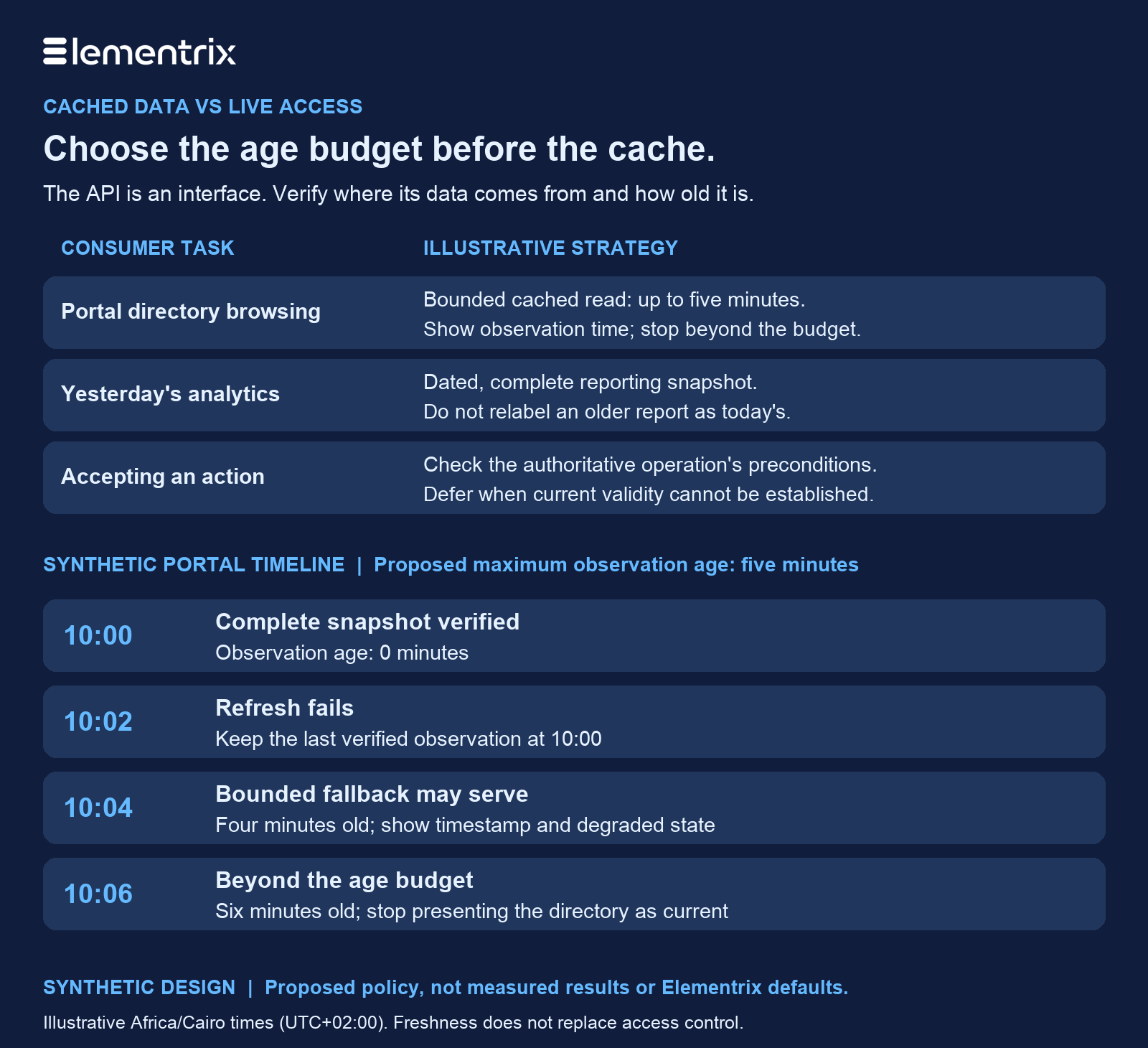
| Consumer task | Candidate strategy and proposed budget | Behavior when the budget cannot be met |
|---|---|---|
| Portal browsing a service directory | Cached read view; at most five minutes since the last verified complete source observation. | Show the observation time while inside budget. Beyond it, stop presenting entries as current and offer a retry. |
| Analytics reviewing yesterday’s completed activity | Published daily snapshot with a declared reporting cutoff and completeness check. | Keep the last completed report clearly dated; do not relabel it as the new reporting day. |
| Operational service-status check before accepting an action | Ask the authoritative service under its supported consistency rules; validate current preconditions when the action is committed. | Defer the action when current validity cannot be established. A convenient older display is not a substitute. |
A single screen can combine these patterns. Cached descriptions can remain visible while the action control waits for a current-state check. Keep those states distinct in the interface and application logic. A fresh check followed by a later write can still race with a concurrent change; the authoritative operation must enforce its own preconditions.
Know what a cache lifetime actually proves
RFC 9111 defines HTTP response freshness from response age and freshness lifetime. A response can be fresh for HTTP caching purposes while its underlying dataset is already delayed. A TTL therefore does not establish an end-to-end business freshness guarantee.
For HTTP responses, no-cache requires successful validation before reuse; it does not simply prohibit storage. must-revalidate prevents reuse after the response becomes stale without successful validation. Respect applicable directives rather than overriding them with an application’s availability preference.
RFC 5861 describes optional, bounded stale-response extensions: stale-while-revalidate permits stale reuse during background revalidation, and stale-if-error permits it for specified error conditions. Check support, configuration and interaction with other directives. These controls do not authorize indefinite stale serving.
Account for age across every layer
If ingestion is delayed and a downstream response is then reused, the consumer can see both delays. Specify which timestamp establishes source observation, which shows publication and which measures response reuse. Do not reset the data’s observation time merely because a refresh attempt started or an old payload was copied into a new cache entry.
Likewise, the time a business value last changed is not always its freshness timestamp. A service description might remain unchanged for weeks while a source observation confirms it today. Record an appropriate observation or completeness watermark, and explain what it establishes and what it leaves unknown.
Work through a failed refresh
Consider a synthetic, read-only service-directory portal. Its owner proposes a maximum observation age of five minutes. The proposed fallback allows the last verified complete snapshot within that boundary, then stops displaying it as current. The times below are illustrative local times in Africa/Cairo, UTC+02:00.
| Time | Event and known observation age | Proposed consumer behavior |
|---|---|---|
| 10:00 | A complete source observation is verified and published. Observation age is zero. | Serve the snapshot with its observation timestamp. |
| 10:02 | The next refresh fails. The last verified observation remains 10:00. | Record the failure; do not advance the observation timestamp. |
| 10:04 | The last verified snapshot is four minutes old. | The approved bounded fallback may serve it with its timestamp and degraded-state indication. |
| 10:06 | The last verified snapshot is six minutes old, exceeding the proposed budget. | Stop treating the directory as current; show unavailable or defer dependent use. |
This is an application freshness policy, not a claim that particular HTTP cache headers implement the whole behavior. It requires monitoring, an owner, tested consumer handling and a trustworthy time reference. If the task cannot tolerate the proposed five-minute gap, choose a smaller budget or a different access path.
After recovery, verify completeness and the relevant observation point before restoring normal operation. An HTTP success or a running refresh job alone does not prove that a usable new snapshot has been published. The broader system-decoupling architecture guide discusses reducing runtime source dependence; the age boundary still needs an explicit consumer decision.
Preserve access boundaries on cached reads
A cached response must not become a route around the current consumer’s permissions. Design reuse boundaries for the tenant, product version, query, record scope and approved field set. Validate the appropriate authorization context on the serving path. Changing an access grant also requires a plan for cached responses, sessions and other copies whose reuse could outlast that decision.
Avoid putting raw secrets in cache keys, debug output or examples. Document whether sensitive responses may be stored, where they live and who can retrieve them. Freshness controls and access controls solve different problems: an answer can be recent yet unauthorized, or permitted yet too old for its task.
Test and document the chosen tradeoffs
Use one representative read task to complete the following review. These are proposed checks, not reported test outcomes.
- Define the boundary. Name the consumer, data owner, delivery path, permitted scope and maximum tolerated age.
- Choose evidence. Identify source-observation, publication and request timestamps, clock assumptions and completeness signals.
- Exercise normal operation. Measure hits, misses, latency distribution, source load and observation age using representative traffic.
- Introduce controlled failures. Test refresh errors, partial updates, source outages, expired entries and recovery without widening access.
- Check the consumer. Confirm timestamp display, stale-boundary handling, exclusions and any authoritative precondition checks.
- Assign operation. Record alert ownership, recovery decisions, change review and the evidence needed to revisit the strategy.
Put the selected expectations in a data product specification. Use measured evidence to refine the policy rather than treating a cache setting as the service contract. The result should state when information is usable, what happens when it is not and who owns that decision.
Discuss the freshness and availability needs of one application.