
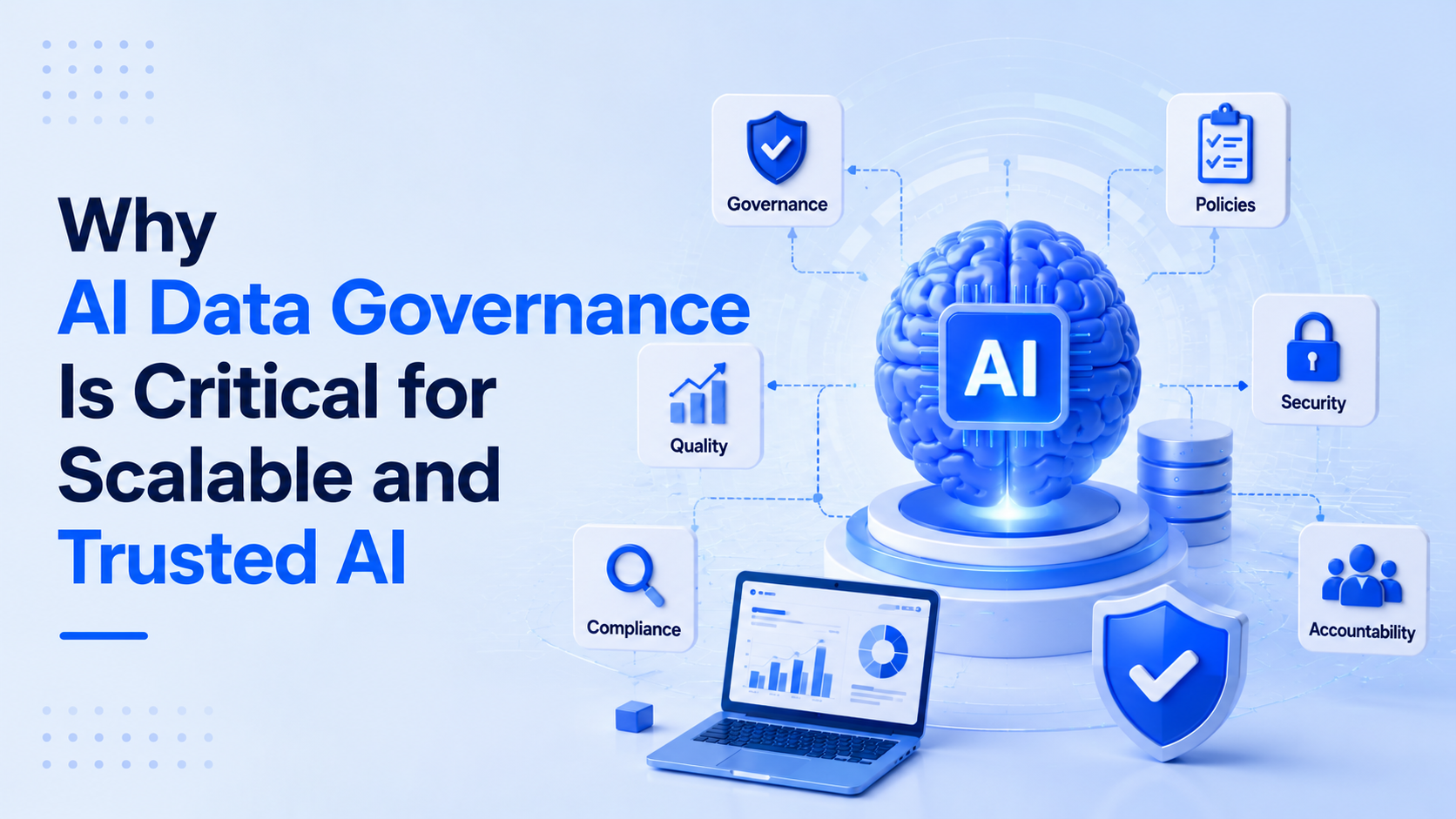
Artificial intelligence is transforming how organizations operate, innovate, and make decisions. From enterprise copilots and predictive analytics to machine learning models and generative AI applications, businesses are rapidly integrating AI into their daily operations.
However, successful AI initiatives require more than powerful algorithms. They depend on high-quality, secure, and governed data. This is where AI data governance becomes essential.
Without proper governance, organizations risk poor AI performance, compliance violations, security breaches, and a loss of trust in AI-generated outcomes. As AI adoption accelerates, enterprises need governance frameworks that ensure AI systems remain accurate, secure, compliant, and scalable.
Why AI Data Governance Matters More Than Ever
The rapid rise of AI across enterprises has created unprecedented opportunities—and equally significant risks.
Modern AI systems rely on vast amounts of data from multiple sources, including:
- Operational databases
- Cloud platforms
- APIs
- Analytics systems
- Enterprise applications
- Customer interactions
If this data is inaccurate, inconsistent, or insecure, AI outputs become unreliable.
Trusted AI starts with trusted data.
Strong governance ensures organizations can:
- Maintain data quality
- Protect sensitive information
- Support regulatory compliance
- Improve AI transparency
- Scale AI safely across the enterprise
This makes governance a foundational requirement for long-term AI success.
👉 Read More : Top Data Governance Challenges and How to Overcome Them
What Is AI Data Governance?
AI data governance refers to the policies, processes, controls, and technologies used to manage and govern data throughout the AI lifecycle.
It ensures that data used by AI systems is:
- Accurate
- Secure
- Compliant
- Traceable
- Accessible only to authorized users
Unlike traditional governance programs, AI governance must address challenges related to machine learning models, training datasets, AI decision-making, and ongoing model performance.
Key components of AI data governance include:
- Data quality management
- Security and privacy controls
- Data lineage tracking
- Access governance
- Compliance monitoring
- Model accountability
👉 Read More : Top Data Governance Solutions for Secure Data Access
Why AI Data Governance Is Critical for Scalable AI
Organizations often struggle to scale AI initiatives because governance is treated as an afterthought.
Without proper controls, enterprises face:
- Data inconsistencies
- Security vulnerabilities
- Model drift
- Regulatory risks
- Unreliable AI outputs
Strong governance enables organizations to scale AI safely while maintaining operational control.
Benefits include:
- Improved trust in AI-generated results
- Reduced compliance risks
- Better model performance
- Consistent enterprise-wide AI adoption
- Faster deployment of AI solutions
Governance transforms AI from experimental technology into a scalable business capability.
👉 Read more :What Is Data Governance? A Complete Guide
The Relationship Between Data Governance and AI
Data Governance for AI Explained
Effective data governance for AI ensures that AI systems operate on trusted, well-managed data.
AI depends on governed data because:
- Models learn from training datasets
- Predictions depend on data quality
- Compliance relies on traceability
- Security requires controlled access
Governance supports every stage of the AI lifecycle, from data collection and model training to deployment and monitoring.
Metadata management, lineage tracking, ownership definitions, and policy enforcement all play critical roles in AI success.
👉 Read more : Best Data Governance Tools
AI Data Quality: The Foundation of Reliable AI
Why AI Data Quality Matters
One of the most common reasons AI projects fail is poor data quality.
The principle remains simple:
Garbage in, garbage out.
Even advanced AI models cannot produce reliable results when trained on inaccurate or incomplete data.
Strong AI data quality practices improve:
- Prediction accuracy
- Decision reliability
- Model fairness
- Business trust
Organizations that prioritize data quality often achieve better AI outcomes and higher adoption rates.
👉 Read more :Build an Internal Data Marketplace with Governance
Common AI Data Quality Challenges
Several issues frequently impact AI performance:
Missing Data
Incomplete records reduce model effectiveness.
Duplicate Records
Duplicates create bias and distort results.
Inconsistent Labeling
Poor labeling affects supervised learning accuracy.
Data Drift
Data characteristics change over time, reducing model relevance.
Outdated Datasets
Stale information leads to inaccurate predictions.
Governance frameworks help organizations identify and address these challenges proactively.
👉 Read more : What Is Data Access Control
AI Data Security and Privacy Challenges
Protecting Sensitive Data in AI Systems
As AI systems gain access to more enterprise data, security becomes increasingly important.
Organizations must address:
- Unauthorized access risks
- Data leakage concerns
- Exposure of training datasets
- AI model misuse
- Insider threats
Weak governance can expose sensitive information and create significant regulatory risks.
AI Data Security Best Practices
Strong AI data security requires multiple layers of protection:
- Access controls
- Data masking
- Encryption
- Secure data delivery
- Continuous monitoring
- Audit trails
These controls help protect both AI systems and the data they consume.
What Are the Biggest AI Governance Risks?
AI introduces new categories of governance risks that organizations must manage carefully.
Data Governance Risks
Common governance risks include:
- Poor data quality
- Weak access controls
- Limited visibility into data usage
- Inconsistent governance policies
AI Governance Risks
Organizations frequently face:
- Hallucinations
- Biased outputs
- Model drift
- Lack of explainability
- Regulatory violations
These issues can reduce trust in AI systems and expose organizations to operational and legal risks.
Operational Risks
Operational governance risks include:
- Shadow AI deployments
- Uncontrolled AI access
- Inconsistent governance standards
- Poor monitoring practices
Without governance, these risks increase significantly as AI adoption grows.
Machine Learning Governance: Managing AI Models Responsibly
What Is Machine Learning Governance?
Machine learning governance refers to the oversight and management of AI models throughout their lifecycle.
This includes:
- Model development
- Testing and validation
- Version control
- Performance monitoring
- Approval workflows
- Compliance reviews
Governance helps ensure models remain reliable, secure, and compliant over time.
Why Machine Learning Governance Matters
Effective machine learning governance supports:
- Trustworthy predictions
- Regulatory readiness
- Continuous model performance
- Reduced operational risk
Organizations that govern models effectively are better positioned to scale AI responsibly.
AI Compliance Challenges in Modern Enterprises
The Growing Regulatory Landscape
AI regulations continue to evolve globally.
Organizations must increasingly comply with:
- GDPR
- EU AI Act
- HIPAA
- Financial services regulations
- Industry-specific requirements
Compliance expectations continue to expand as AI becomes more integrated into business operations.
Common AI Compliance Challenges
Common AI compliance concerns include:
- Data privacy requirements
- Explainability mandates
- Audit readiness
- Documentation obligations
- Cross-border data governance
Governance frameworks help organizations maintain compliance while supporting innovation.
How to Build an Effective AI Data Governance Framework
A successful governance framework should focus on several core principles.
Define Governance Ownership
Establish clear accountability for AI systems and data assets.
Establish AI Policies and Standards
Create consistent governance requirements across teams.
Improve Data Quality Processes
Implement validation, cleansing, and monitoring workflows.
Implement Runtime Governance
Apply policies dynamically during AI operations.
Monitor AI Usage and Outcomes
Track model performance and business impact continuously.
Maintain Auditability and Compliance
Ensure complete visibility into AI activities and decisions.
The Role of Data Access Governance in AI
AI systems require controlled access to enterprise data.
Organizations must govern:
- Training data
- Retrieval pipelines
- Enterprise knowledge bases
- AI-powered applications
Policy-based access controls help ensure AI systems only access approved information.
This protects sensitive business data while supporting trusted AI operations.
How Modern Platforms Enable Trusted AI
Modern governance platforms provide critical capabilities for AI initiatives, including:
- Governed data products
- Secure data access
- Centralized policy enforcement
- Auditability and lineage
- AI-ready data delivery
These capabilities help organizations scale AI while maintaining security and compliance.
Best Practices for AI Data Governance
Organizations should follow several proven practices:
- Prioritize AI data quality
- Apply least-privilege access controls
- Govern AI training datasets
- Monitor model behavior continuously
- Implement AI compliance controls
- Use centralized governance platforms
These practices improve trust, security, and scalability across AI initiatives.
The Future of AI Data Governance
The future of governance is increasingly automated and intelligent.
Emerging trends include:
- AI governance automation
- Policy-as-code
- Real-time governance enforcement
- Responsible AI frameworks
- Governed AI agents and copilots
- Trusted enterprise AI ecosystems
Organizations that invest in governance today will be better prepared for tomorrow’s AI-driven environments.
Frequently Asked Questions
What is AI data governance?
AI data governance is the framework of policies, controls, and processes used to manage, secure, monitor, and govern data used by AI systems.
Why is governance important for AI?
Governance ensures AI systems remain secure, compliant, trustworthy, and powered by high-quality data.
How to ensure data quality for AI?
Organizations can improve AI data quality through validation, cleansing, monitoring, lineage tracking, and governance controls.
What are AI governance risks?
Common risks include poor data quality, biased models, hallucinations, compliance violations, weak security, and lack of transparency.
What is machine learning governance?
Machine learning governance is the practice of overseeing AI models through monitoring, validation, version control, approval workflows, and compliance management.
Build Trusted AI with Strong Data Governance
Successful AI initiatives require more than powerful models—they require trusted, governed, and secure data.
Elementrix helps organizations build trusted AI through secure data access, governed data products, centralized policy enforcement, and enterprise-grade governance controls.
Start building scalable and trustworthy AI with Elementrix today.
Final Thoughts
As AI adoption accelerates, organizations must ensure that the data powering their AI systems is secure, accurate, governed, and compliant.
Without strong AI data governance, enterprises face increasing risks related to data quality, security, compliance, and trust.
Organizations that invest in robust governance frameworks, machine learning governance practices, and AI-ready data architectures will be better positioned to scale AI responsibly and effectively.
Elementrix , enterprises can establish trusted AI foundations through governed data access, secure delivery, and scalable enterprise governance.