
Your AI Agent Shouldn’t Query Production Databases: Build Governed AI Data Access with Elementrix
Enterprise copilots are easy to demo — but dangerous to deploy without governed AI data access.
The problem usually isn’t the LLM itself.
The real problem is uncontrolled access to enterprise data.
Who can retrieve what?
For which purpose?
Under which masking rules?
From which approved source?
With what audit trail?
And how do you revoke access instantly when something goes wrong?
That’s where many enterprise AI projects fail.
Teams connect AI agents directly to internal systems, add RAG pipelines, and assume the architecture is complete. Then the predictable problems appear:
- AI agents query production databases directly
- Raw exports feed vector indexes
- Sensitive fields leak into answers
- Nobody can explain which policies were applied
- Access cannot be revoked quickly
This is where enterprise AI becomes risky.
If your organization wants usable AI without turning enterprise data into an uncontrolled data plane, the solution is not “better prompts” or more retrieval tuning.
👉 The solution is a governed AI data access layer.
What is AI Data Access?
AI data access is the governance model that controls how copilots, assistants, and AI agents retrieve enterprise data at runtime.
It’s not just about connectivity.
It’s about governance, security, and control.
A mature AI data access model defines:
- What data products an AI system may access
- Which fields can be returned
- How sensitive values are masked
- What business purpose the request serves
- How every request is audited
- How access is revoked when risk changes
Without these controls, AI systems simply automate and scale weak access models that already exist.
Why AI Agents Shouldn’t Query Production Databases Directly
Direct production database access is one of the fastest ways to turn a promising AI pilot into a security, compliance, and reliability problem.
When AI agents query operational systems directly, several risks appear immediately:
- Sensitive fields may be returned without proper shaping
- Purpose-based access becomes difficult to enforce
- Every new tool call increases database load
- Auditability becomes fragmented
- Revocation becomes slow and operationally messy
Temporary direct read access often becomes a permanent backdoor — especially when teams move fast under pressure.
This is also aligned with broader AI security guidance. OWASP highlights that AI agents introduce unique security risks because they can reason, use tools, maintain memory, and take actions across systems.
That dramatically expands the attack surface.
The Real Problem: AI Amplifies Weak Data Governance
LLMs do not fix bad governance.
They amplify it.
If your enterprise already suffers from:
- Fragmented access paths
- Shadow exports
- Inconsistent KPI definitions
- Tool-specific permissions
- Weak data governance
AI copilots will expose those problems much faster.
That’s why many enterprise AI deployments fall into one of two bad outcomes:
❌ The copilot becomes useful but risky
or
❌ The copilot becomes safe but useless
The goal is controlled usefulness.
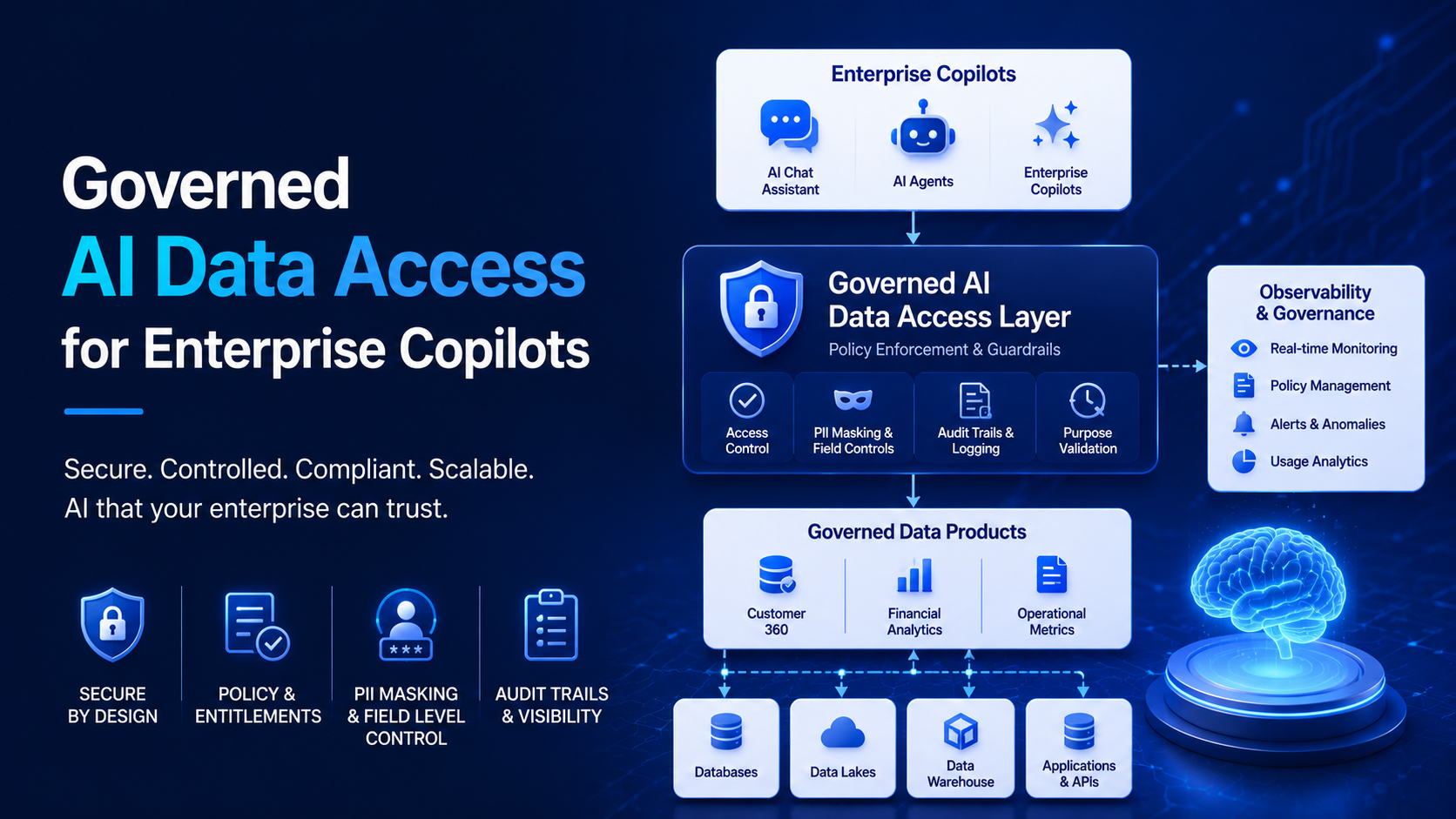
The Better Architecture: Governed AI Data Access
The safest approach is not allowing every AI assistant to connect directly to enterprise systems.
The better pattern is:
AI Systems → Governed AI Data Access Layer → Enterprise Data
In this architecture:
- Copilots route requests through an orchestrator or LLM gateway
- The gateway handles routing, validation, and guardrails
- AI tools call governed endpoints instead of raw databases
- Elementrix enforces policy before data is returned
- Retrieval happens through approved data products
- RAG uses approved indexes instead of unmanaged exports
This creates a secure and scalable enterprise AI architecture.
What a Governed AI Data Access Layer Actually Does
A governed AI data access layer does much more than proxy a query.
It becomes the runtime control plane for enterprise AI.
This includes:
- Enforcing product contracts
- Checking entitlements
- Validating request purpose
- Applying field-level rules
- Masking PII
- Shaping payloads for AI-safe use
- Logging access decisions
- Supporting fast revocation
AI systems do not need raw database tables.
👉 They need policy-safe outputs.
That’s why copilots should access governed data products — not arbitrary production systems.
Why Governed Data Products Matter
A governed data product gives AI systems a stable, secure, reusable interface.
Instead of allowing copilots to hit production tables directly, the system should expose:
- Stable schemas
- Clear ownership
- Versioning rules
- Approved metrics definitions
- Policy-based controls
- AI-optimized payloads
This dramatically reduces:
- Data leakage risk
- Semantic drift
- Operational instability
- Performance bottlenecks
Why RAG Governance Matters
Many organizations assume the problem is solved once they build a vector index.
But unsafe indexing is simply another form of weak governance.
If RAG pipelines rely on raw exports:
- Sensitive data can leak into embeddings
- Access controls become disconnected
- Retrieval becomes difficult to audit
- Revocation becomes nearly impossible
That’s why governed RAG matters.
A secure enterprise AI system ensures:
- Only approved sources are indexed
- Indexing follows policy rules
- Retrieval remains traceable
- Content can be removed when access changes
- AI responses are grounded in approved knowledge
Why Purpose-Based Access Matters for Enterprise AI
Traditional access control asks one question:
“Who is the user?”
For enterprise AI, that isn’t enough.
You must also ask:
“Why is this request being made?”
The same employee may use a copilot for:
- Customer support
- Operations reviews
- Executive reporting
- Incident management
Each scenario may require different access rights.
Purpose-based access becomes critical for secure enterprise AI governance.
👉Read more : What Is Data Governance? A Complete Guide
Why Payload Shaping Is a Security Control
Payload shaping is not just a UX optimization.
It directly impacts:
- Leakage risk
- Latency
- Token cost
- Hallucination probability
- Prompt injection exposure
A secure AI system should never return raw datasets if the task only needs:
- A summary
- A masked identifier
- A limited status response
- A policy-approved subset of data
Elementrix enables policy-aware payload shaping that suppresses sensitive identifiers, limits unnecessary detail, and adds governance metadata automatically.
👉Read more : Top Data Governance Solutions for Secure Data Access
The End-to-End Runtime Journey
A secure enterprise AI request should follow a predictable workflow.
1. A user submits a request
The copilot receives a business question.
2. Guardrails execute
The orchestrator validates intent and applies safety checks.
3. The AI selects a governed tool
Instead of arbitrary SQL queries, the AI accesses approved data products.
4. Governance policies are enforced
Elementrix applies:
- Entitlement checks
- Purpose validation
- Field-level controls
- PII masking
- Audit logging
5. Data is retrieved safely
The request reads from a decoupled product layer instead of operational systems.
6. A policy-safe payload is returned
Only approved data is delivered to the AI.
7. RAG uses approved retrieval sources
No unmanaged exports or uncontrolled indexes.
8. The full request remains auditable
Every prompt, tool call, policy decision, and response is traceable.
Why This Architecture Improves Performance Too
Governed AI data access isn’t only about security.
It also improves scalability and performance.
When copilots repeatedly hit operational systems directly, they create:
- Concurrency spikes
- High database load
- API performance issues
- Unpredictable runtime pressure
As agentic workflows grow, tool calls increase rapidly.
A decoupled product layer reduces pressure on production systems and enables more stable AI runtime performance.
👉Read more : Best Data Governance Tools
How Elementrix Enables Governed AI Data Access
Elementrix acts as the governed delivery layer between enterprise AI systems and enterprise data.
It enables:
- Governed data products
- Policy-based access enforcement
- AI-safe payload delivery
- Field-level entitlements
- Approved RAG pipelines
- Audit trails and revocation
- Decoupled, low-latency reads
Instead of AI agents connecting directly to production systems, Elementrix provides controlled, scalable, policy-aware access.
Why This Matters Now
Enterprise AI adoption is accelerating quickly.
But governance still determines whether these systems survive production reality.
If AI agents can access everything:
❌ You create risk.
If they can access almost nothing:
❌ You lose business value.
The winning model is controlled usefulness.
That requires:
- Governed AI data access
- Approved data products
- Policy-aware responses
- Secure retrieval pipelines
- Auditability
- Instant revocation paths
This is the shift from “AI connected to enterprise systems” to enterprise AI with governed data access.
👉Read more :What Is a Data Intelligence Platform
Final Takeaway
Your AI agent should not query production databases directly.
It should access governed data products through a policy-enforced AI data access layer that understands:
- Entitlements
- Purpose
- Masking
- Auditability
- Performance constraints
That is how enterprise organizations make AI copilots useful without making them dangerous.
FAQs
What is AI data access?
AI data access is the governance model that controls how copilots and AI agents retrieve enterprise data, including permissions, masking, purpose validation, and auditability.
Why shouldn’t AI agents query production databases directly?
Because direct production access increases leakage risk, weakens governance, complicates revocation, and can overload operational systems.
What is a governed AI data access layer?
It is a runtime governance layer that enforces policies before data is delivered to AI tools, including masking, entitlements, shaping, and audit logging.
What is RAG governance?
RAG governance ensures retrieval indexes are built only from approved content under governance policies with traceability and revocation support.
Why is purpose-based access important for enterprise AI?
Because the same user may use AI systems for different business functions, and each purpose may require different data permissions.
How does Elementrix help?
Elementrix enables governed AI data access through policy enforcement, governed data products, approved retrieval pipelines, field-level controls, and secure runtime delivery.
Enterprise AI should not depend on uncontrolled production database access.
Discover how Elementrix helps organizations build governed AI data access with secure data products, approved RAG pipelines, field-level governance, and scalable runtime protection.