
A data product specification template should record the product’s purpose, accountable owner, consumers, approved scope, schema, quality rules, freshness expectations, delivery interface, and change process. Make each commitment testable and assign someone to respond when it fails. The worksheet below helps a product owner turn an informal request into a reviewable design.
Consider a service application asking for “customer data.” That phrase leaves essential decisions open: which customer identifier, what account status means, which records the application may see, how old the data may be, and what happens during an outage. A specification resolves those questions before they become different assumptions in three teams.
Use the blank worksheet first, then compare it with the filled customer-status example. All example identities, fields, values, targets, and interfaces are synthetic design choices; they are not customer results or promised Elementrix settings.
What belongs in a data product specification
A useful specification connects business intent to a maintained consumption contract. It should be understandable to the product owner, the engineer implementing delivery, the person approving access, and the consumer integrating it. Keep those readers together rather than producing an isolated schema document.
For the broader concept, start with our guide to what a data product is. This article focuses on the worksheet needed to design one. It does not prescribe a particular catalog, contract format, or software implementation.
Open specifications provide useful structures for a later machine-readable version. The Open Data Product Specification covers product details, access, quality, service expectations, and other metadata. The Open Data Contract Standard separates schema, quality, team, support, and service-level information. The worksheet here is an original planning aid, not a conformant export of either standard. If you adopt a standard, map and validate the completed document against its chosen version.
Copyable data product specification template
Copy this table into your working document. Replace every prompt with a decision, a named owner, or an explicitly tracked open question. Link to maintained schemas and policies instead of copying long documents that will drift out of date.
| Section | Fill in these decisions | Evidence needed for review |
|---|---|---|
| Identity and lifecycle | Product ID; name; domain; version; draft/pilot/live status; specification owner and revision date. | A stable identifier and a maintained location for the current specification. |
| Purpose and boundaries | Consumer task; useful outcome; supported uses; excluded uses; success measure. | A consumer confirms the product answers a specific question or supports a specific action. |
| Ownership and support | Accountable product owner; source steward; delivery operator; support channel; escalation and review dates. | Each responsibility has an accepted owner; support hours and response expectations are stated. |
| Consumers and access | Application or user identities; purpose; permitted records and fields; approval, expiry, and review rules. | A separate scope decision per consumer, plus a plan to test denial and revocation. |
| Sources and meaning | Authoritative source for each field; business definitions; transformation and join rules; lineage reference. | Definitions resolve ambiguous values and source conflicts. |
| Schema and examples | Field names; types; nullability; key/grain; allowed values; timestamps; representative synthetic payload. | A versioned schema and examples that match it, including empty and invalid cases. |
| Quality controls | Rule; threshold; measurement window; check location; owner; action on failure. | A test or monitor can measure the rule and route a failure to an accountable responder. |
| Freshness and availability | Source event time; refresh cadence; maximum acceptable age; service window; degraded behavior. | The timestamps needed to measure age and a clear consumer response to stale or unavailable data. |
| Delivery and usage | Interface and version; authentication; authorization boundary; limits; errors; allowed downstream storage and use. | A consumer can integrate the documented interface and verify permitted and denied behavior. |
| Change and retirement | Compatibility policy; impact review; notification; migration window; rollback; retirement and evidence links. | Affected consumers are identifiable and have an agreed transition path. |
“TBD” is acceptable during design only when it has an owner and a due date. A product should not enter a live operating state while an unresolved decision prevents consumers from understanding access, meaning, freshness, or failure behavior.
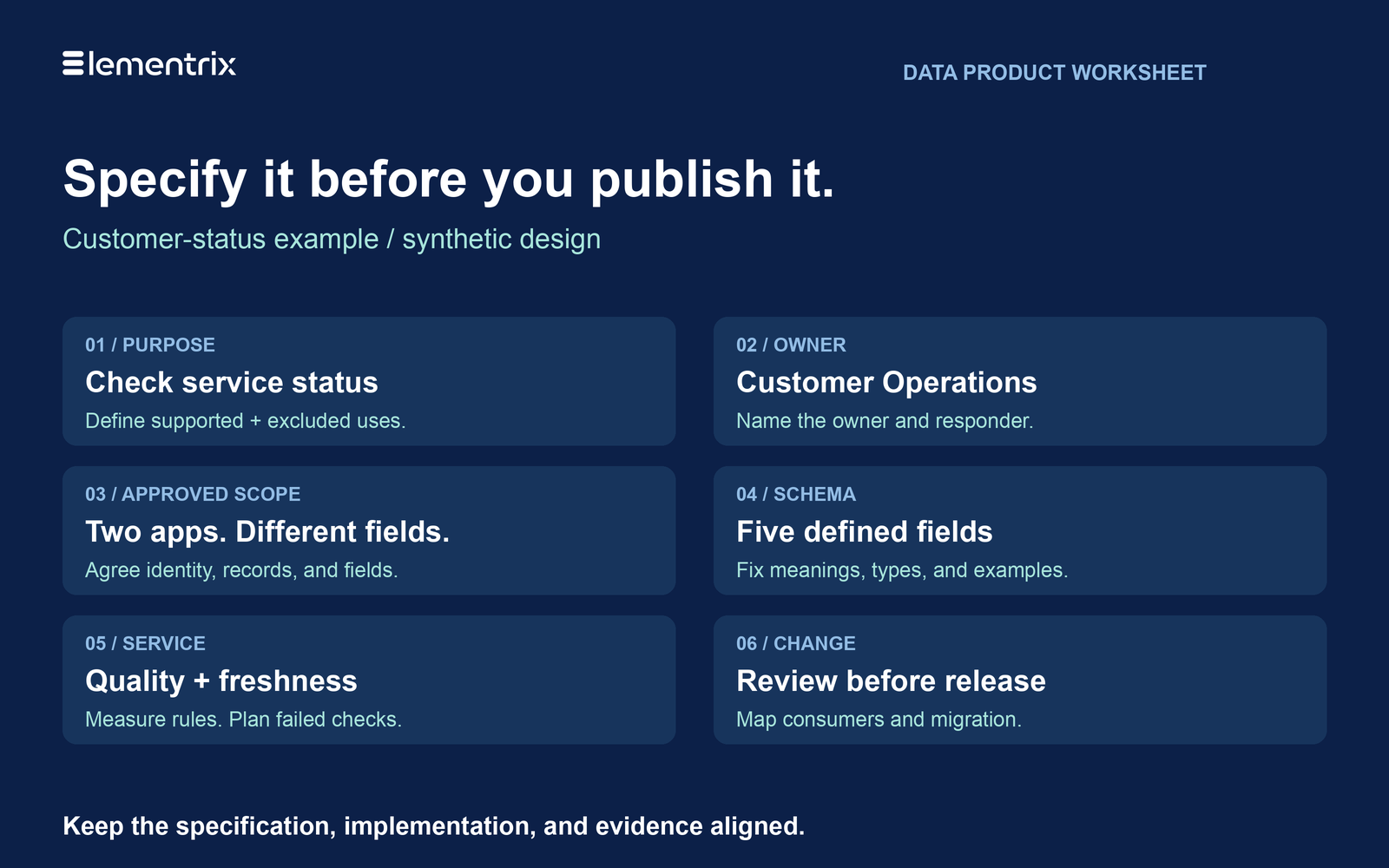
Owner, consumers, purpose, and approved fields
Start with the consumer’s task. “Customer 360” is a label; “let a support application check whether an account is active in its assigned service region” is a scope that reviewers can assess. State what the product deliberately excludes, such as marketing segmentation, identity verification, or credit decisions.
Name the accountable owner separately from the operator. The owner accepts definitions and supported use; the operator implements delivery and responds to service failures. A source steward resolves incorrect source values. One team may perform several roles, but none should be assumed simply because it created the first table.
Document both record scope and field scope. A consumer approved for account status is not necessarily approved for every customer or every column. Record the identity used at runtime, the applicable region or tenant boundary, and the behavior when a consumer asks for something outside its grant.
Schema, quality, freshness, and delivery contract
Give each field one operational meaning
Specify the grain before listing columns: one current status record per customer, one record per account, or a history of status events. Define whether a missing row means unknown customer, unavailable source data, or an access decision. Those cases may require different responses. Document which timestamp represents the business event and which represents delivery preparation.
Turn service language into measurable checks
Replace “high quality” with a rule, a measurement, and an action. For example, a design might require every served status to belong to an agreed enum and reject a refresh containing duplicate keys. Record whether the monitor checks the source, the prepared product, or the response; a check in one location does not prove the others are correct.
Likewise, a refresh every five minutes does not prove data is at most five minutes old. Source delays, processing failures, and caches can add age. State the timestamp used to evaluate freshness and what the interface does when the limit is exceeded. Treat thresholds as proposed commitments until the team has measured and accepted them.
Describe the consumer-visible interface
Include request shape, response schema, authentication, authorization, limits, and error meanings. If you plan to reject out-of-scope fields, say so and test it. If the interface always returns a fixed approved projection, document that instead. Link the specification to the exact interface definition and deployment version so a consumer can identify what is currently supported.
Our guide to governed data products for enterprise delivery gives the surrounding architectural context. The specification still needs explicit implementation decisions and evidence for its own delivery path.
A filled customer-status product example
Synthetic example: Customer Status for Service Operations. A fictional enterprise needs two applications to consume a limited current-status product. Every value below is illustrative. The five-minute cadence, fifteen-minute age limit, and migration periods are proposed targets for the example, not measured service levels.
| Section | Example decision |
|---|---|
| Identity | ID: service.customer-status; version 1.0; lifecycle: design; grain: one current record per customer_id. Specification revision: 2026-10-09. |
| Purpose | Support staff check current service status. A regional operations app routes service work. Excludes marketing, identity verification, and credit assessment. |
| Ownership | Accountable: Customer Operations product owner. Source meaning: CRM steward. Delivery and monitoring: data platform team. Consumer integrations: each application owner. |
| Source and transformation | Synthetic CRM status history supplies customer_id, account_status, service_region, and status_changed_at. Choose the latest source event per customer; conflicting events with equal timestamps fail validation. Generate product_as_of for each complete refresh. |
| Consumer access | support-status-app: assigned-region records and four permitted fields. regional-routing-app: assigned-region records and all five fields. Product owner approves each scope; review after 90 days or a purpose change. |
| Quality and freshness | Reject duplicate customer_id values or invalid status enums in a candidate refresh. Refresh target: every 5 minutes. Require a complete source checkpoint within 15 minutes; product_as_of reflects that checkpoint, not just the processing clock. |
| Delivery | Illustrative HTTPS JSON lookup: GET /v1/customer-status/{customer_id}. Authenticate the application and enforce its region and field projection at delivery. Unknown or out-of-region identifiers return the same non-disclosing not-found response. |
| Failure and support | If a refresh fails, keep the last valid snapshot only while its source checkpoint stays within the 15-minute limit. Once stale, return a documented unavailable response rather than silently serving old status. Alert the data platform team; log and track recovery. |
| Change and retirement | Proposed major version for breaking field or meaning changes. Notify registered consumers and agree migration; example planning window: 30 days. Extend the window if consumers cannot migrate safely. Keep rollback criteria and the old-version retirement decision in the release record. |
| Field | Type and nullability | Meaning and example |
|---|---|---|
| customer_id | String; required; unique in a snapshot. | Opaque enterprise customer key; example CUST-042. Not a national identifier. |
| account_status | String; required; enum. | Current service state: active, suspended, or closed. Example active; not a creditworthiness signal. |
| service_region | String; required; controlled code. | Operational region assigned to the customer; example REGION-A. Drives the illustrative record-scope rule. |
| status_changed_at | Timestamp; required; UTC. | When this status took effect in the authoritative source; example 2026-10-09T05:45:00Z. An unchanged status may legitimately have an old event time. |
| product_as_of | Timestamp; required; UTC. | Source completeness checkpoint represented by the snapshot; example 2026-10-09T06:00:00Z. Used to evaluate freshness; retained in delivery monitoring even when omitted from a consumer response. |
| Field | support-status-app | regional-routing-app |
|---|---|---|
| customer_id | Allowed | Allowed |
| account_status | Allowed | Allowed |
| service_region | Allowed | Allowed |
| product_as_of | Allowed | Allowed |
| status_changed_at | Excluded | Allowed |
Both consumers are restricted to their assigned region. Neither receives email, postal address, national identifier, or payment details: those fields are outside the defined product. The example uses a fixed projection for each application; a requested expansion requires a new scope review.
A synthetic support-status-app response would therefore contain only its four approved fields:
{
  "customer_id": "CUST-042",
  "account_status": "active",
  "service_region": "REGION-A",
  "product_as_of": "2026-10-09T06:00:00Z"
}
Notice the two timestamp meanings. An account may have been active for weeks without making its status stale. Freshness depends on evidence that the source was checked completely and recently, not on pretending that the business status changed at every refresh. If your source cannot supply a reliable checkpoint, document a different measurable freshness basis and validate it before promising a limit.
Review and change-control checklist
Run a review with the owner, operator, access reviewer, and one representative consumer. Capture proposed acceptance tests now; add actual results and evidence after implementation. A checked box in a planning document is not evidence that a runtime control works.
- Purpose: Can a consumer name the task this product supports and the uses it excludes?
- Meaning: Do grain, enums, nulls, missing records, and timestamps have unambiguous definitions?
- Access: Does each consumer have its own approved identity, record scope, field scope, and review date?
- Positive test: Can an approved consumer retrieve a representative response matching the schema?
- Negative tests: Are unauthenticated requests, out-of-region records, and excluded fields handled as documented?
- Failure tests: Does a duplicate-key refresh fail safely, and does stale data produce the agreed response?
- Operations: Can someone measure the commitments, receive an alert, and restore service?
- Changes: Can the team find affected consumers, notify their owners, and prove migration before retirement?
Keep a small review record with decision, approver, date, evidence link, unresolved issue, and next action. On a schema, source, purpose, or consumer-scope change, reopen the affected sections rather than assuming the previous approval covers the new behavior. Routine wording fixes can follow a lighter process; changed semantics deserve a compatibility review.
Use the specification in a product walkthrough
Start with one product and one consumer. Complete the worksheet, mark unaccepted targets, and bring the unresolved decisions to the people who own them. Keep the specification version aligned with the implemented interface and its operational evidence.
Use this specification to walk through a product in an Elementrix demo. Bring your purpose, schema, consumer identities, and approved-field matrix. Ask which requirements the current implementation supports directly, which require integration, and which still need validation.