
A data catalog helps people find and understand data. An internal data marketplace organizes the journey from finding a suitable product to requesting, receiving, and managing access to it. The capabilities overlap: catalogs can include request workflows, and marketplaces can rely on catalogs for metadata. Choose by the consumer workflow you need to complete, rather than the category on the vendor’s homepage.
If your team can locate a customer dataset but still needs several tickets to use it, discovery is only part of the problem. If approved access already works and users mainly struggle with definitions or provenance, a new marketplace interface may not address the real gap. This comparison gives data platform leaders and enterprise architects a capability table, a decision path, and three illustrative buying scenarios.
Data catalog vs data marketplace: finding data and consuming it
A catalog usually centers on metadata: asset names, schemas, business definitions, ownership, classifications, lineage, and search. It helps a reader decide what exists, what it means, and whether it is suitable. A well-maintained catalog can be valuable even when delivery happens in another system.
A marketplace centers on the consumer experience around reusable offerings. A product listing should explain what the consumer can use, for which purpose, through which interface, under which access conditions, and with whose support. An internal marketplace does not require selling data or charging money. An external marketplace adds questions about commercial terms and partner boundaries.
Neither label proves that permissions are enforced. A request marked “approved” must lead to a usable grant at the actual query, file, or API boundary. Check which parts are built in, which use integrations, and which still depend on manual operations. For the broader rollout, see our internal data marketplace launch guide.
Compare capabilities, not just category names
Use this table as a requirements map, not a claim that every product in a category behaves alike. “Marketplace emphasis” describes what a consumer-oriented implementation should resolve; it is not a universal feature guarantee.
| Capability | Catalog emphasis | Marketplace emphasis | Evidence to request |
|---|---|---|---|
| Discovery and meaning | Search assets, definitions, classifications, and lineage. | Find curated offerings with business purpose and usable access methods. | Locate a relevant product using business language; explain an ambiguous field. |
| Ownership | Identify owners and stewards in metadata. | Make the owner responsible for the offering, requests, and support. | Show who receives a request and who handles a broken delivery path. |
| Approval | May include workflows or connect to a request system. | Keep the request, decision, and access status in a coherent consumer journey. | Submit a justified request; demonstrate approval and rejection. |
| Contracts and expectations | Record schemas, definitions, and documentation. | Expose supported use, interface, freshness, version, and change expectations. | Show what a consumer agrees to and how changes are communicated. |
| Delivery and enforcement | May point to a source or provision access through integrations. | Connect an approved request to the consumer’s actual consumption path. | Use the approved identity to query or call the interface; test a denied request. |
| Access lifecycle | May track governance state and access relationships. | Make expiry, revocation, and support visible to consumers and owners. | Revoke a grant and confirm the next request is denied at the relevant boundary. |
The overlap is concrete. Amazon DataZone’s official documentation describes catalog search followed by subscription requests, owner approval, and fulfillment. It distinguishes managed assets, where access can be fulfilled by the service, from unmanaged assets that require custom integrations. This is a useful reminder to inspect the source types and delivery paths covered by a demonstration.
Likewise, Collibra’s access-request documentation describes tracking request status and purpose in its marketplace. Request tracking is useful evidence of a consumer workflow; it is not, on its own, evidence that every downstream runtime enforces the decision.
A decision path for your existing platform
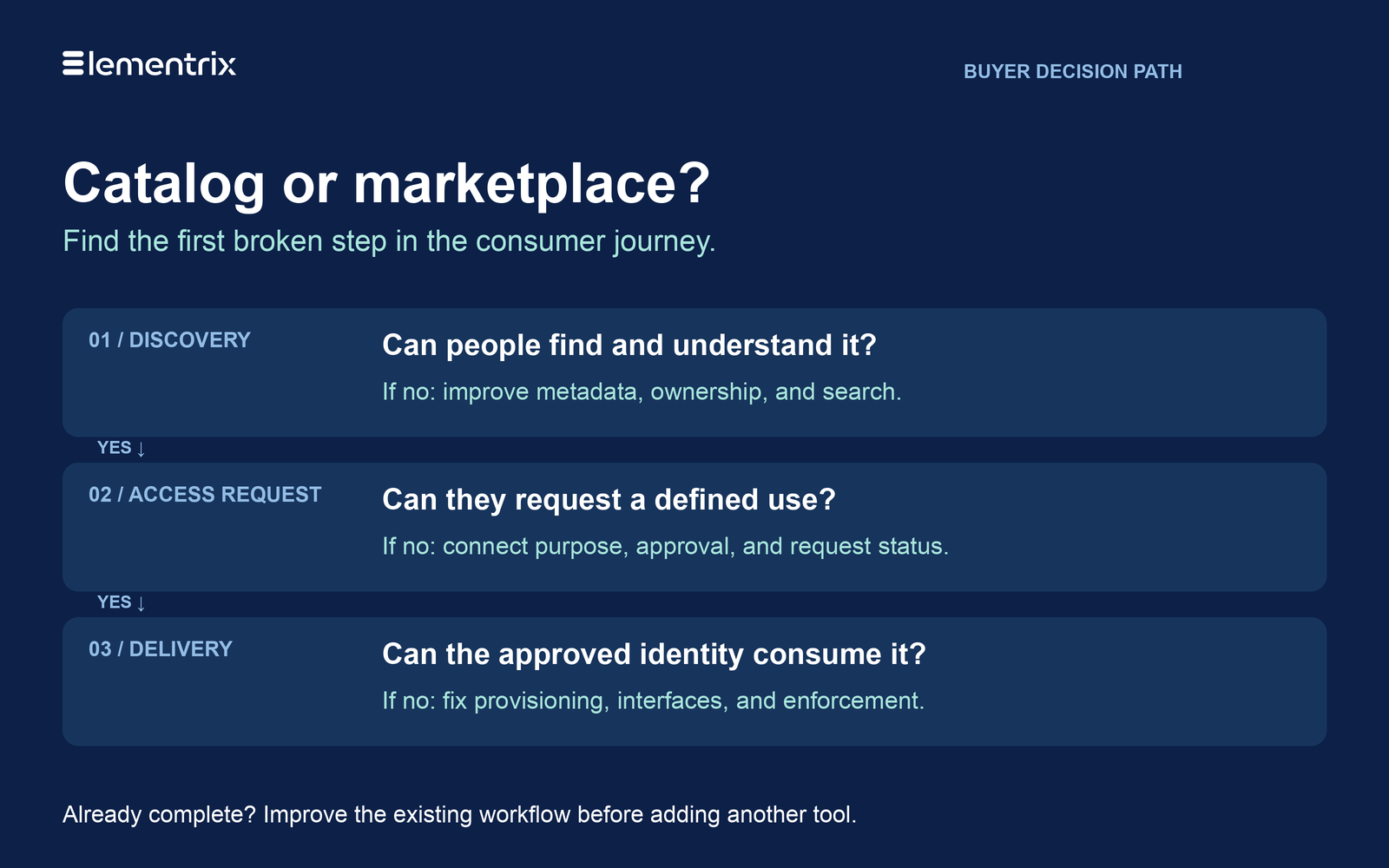
Start with one important consumer and identify the first step that fails. The following path helps distinguish a metadata problem from an approval or delivery problem.
- Consumers cannot find or interpret the right data: prioritize metadata coverage, business definitions, ownership, and search. Evaluate catalog capabilities first.
- Consumers find the right offering but cannot request access consistently: assess the request experience, required purpose, owner routing, decision records, and status visibility. A marketplace layer or an extension to your existing catalog may fit.
- Requests are approved but consumers cannot use the data reliably: inspect provisioning, identities, permitted fields, interfaces, freshness, and operational support. A new storefront will not fix an incomplete delivery integration.
- The workflow already completes: improve weak steps in the existing platform before adding another inventory or request system.
Where a catalog and marketplace work together
A practical architecture can keep the catalog as the metadata foundation and present selected offerings through a marketplace experience. Stable identifiers connect a product listing to its source assets. The listing adds consumer-facing purpose, access method, service expectations, and support information. Request decisions then flow to the system that creates and enforces the grant.
Avoid making two competing records for the same owner, schema, or classification. Decide which system owns each attribute, how updates are propagated, and what happens when synchronization fails. The catalog may own technical metadata while a domain team owns the product’s intended use and support commitments. The implementation must make that division explicit.
For the offering itself, our guide to data products explains the connection between reusable data, ownership, documentation, and consumption. A marketplace listing should represent that maintained offering, rather than simply rename every source table as a product.
Three scenarios to use in a buying discussion
The following scenarios are synthetic examples, not Elementrix customer stories or measured test results. Each asks for a different form of access, so a successful demonstration in one scenario does not establish readiness for the others.
An analyst needs a trusted revenue definition
A finance analyst finds several monthly revenue tables. The first requirement is a definition: recognized revenue versus invoiced revenue, reporting currency, and the date used for attribution. Ask the vendor to show definitions, provenance, an accountable owner, and a freshness expectation. If the analyst also needs warehouse access, continue through a request and an actual query with the approved identity. Strong discovery plus an existing grant process may be enough.
An application needs a limited customer-status response
A service application needs customer identifier, account status, and service region. It does not need email or national identifier. Ask for a documented interface and a grant bound to the intended application. Then use that identity to retrieve the allowed response and attempt to retrieve an excluded field. Decide whether the contract omits the field or rejects the request, and test that behavior. An analyst’s warehouse subscription does not automatically meet this application delivery requirement.
An external partner needs a controlled shipment feed
A logistics partner needs shipment status for an agreed purpose and period. The evaluation must cover partner identity, approved records and fields, allowed use, support, freshness, and access expiry. Where commercial or legal terms apply, identify who approves them; a marketplace does not supply those decisions by itself. Test withdrawal of access at the delivery boundary, and define how downstream copies are handled. Revoking future access cannot automatically erase data already exported.
Questions to ask in a vendor demo
Bring a representative product and a consumer identity. Ask the presenter to complete the workflow in the environment you intend to use, and record the integration work that remains.
| Question | Acceptance evidence |
|---|---|
| Can a consumer understand the product without contacting its creator? | Purpose, owner, field definitions, freshness, interface, and support are visible. |
| What exactly does approval authorize? | The decision identifies the consumer, purpose, scope, and any expiry; partial approval has defined behavior. |
| Where is the decision enforced? | An actual query or API response uses the approved identity; an unauthorized request is denied. |
| Which sources and interfaces need custom work? | A written boundary separates built-in fulfillment, connectors, and manual or custom steps. |
| What happens after a schema or grant changes? | A change and revocation test shows consumer behavior, notifications, and traceable evidence. |
| Who operates the failed steps? | Owners are named for metadata, requests, identity, delivery, synchronization, and support. |
Keep an evidence worksheet with these columns: requirement, consumer, demonstrated result, integration dependency, responsible owner, and unresolved question. Mark a capability “demonstrated” only after observing the required behavior. An attractive search screen or an approved-request badge should not receive credit for delivery that has not been tested.
Choose the smallest change that completes the workflow
A catalog, a marketplace, or a combination can be the right choice. The useful distinction is whether people can understand the data, request an appropriate use, receive enforceable access, and continue consuming it as conditions change. Buy against that sequence and its operating responsibilities.
To compare your required discovery-to-delivery workflow with the Elementrix team, bring one product and one consumer scenario to a focused demo. Use the comparison table to agree what must be shown and what integration work needs further validation.