
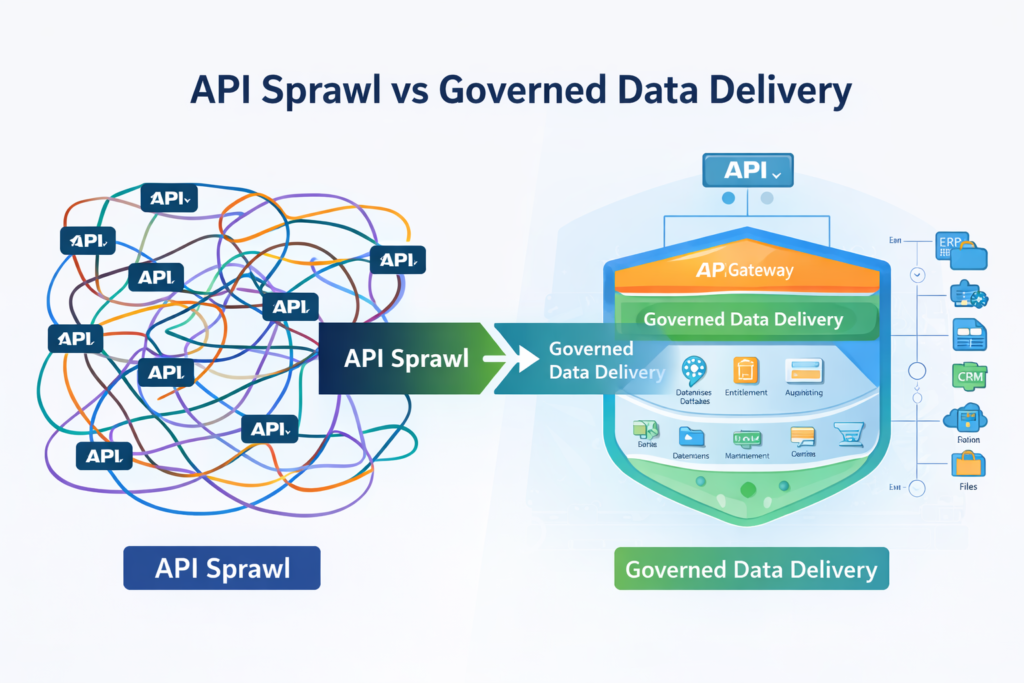
API sprawl has become one of the most serious challenges in modern enterprise architecture.
As organizations scale microservices, digital channels, partner integrations, and analytics platforms, new APIs are created for every consumer variation. Over time, this leads to duplicated endpoints, inconsistent contracts, performance bottlenecks, and fragmented governance.
If you are searching for:
- How to reduce API sprawl
- How to prevent API sprawl in microservices
- API sprawl governance solutions
- Whether API Gateway is enough
This article outlines a modern architecture pattern that solves API sprawl structurally — not incrementally.
What Is API Sprawl in Enterprise Architecture?
API sprawl refers to the uncontrolled growth of APIs across an enterprise, often driven by:
- Consumer-specific payload requirements
- Version fragmentation
- Lack of centralized governance
- Microservices autonomy without architectural guardrails
Instead of reusable contracts, organizations end up with:
- Dozens of similar endpoints
- Slight schema variations
- Redundant business logic
- Expensive maintenance overhead
In many enterprises, API sprawl becomes an operational risk rather than a productivity gain.
Why API Gateways Alone Cannot Solve API Sprawl
Most enterprises deploy API Gateways such as Apigee, Kong, or WSO2 to control ingress traffic.
API Gateways are excellent at:
- Authentication and identity validation
- Rate limiting and quotas
- Routing and traffic management
- Edge-level security enforcement
However, API sprawl is not a traffic problem.
It is a governance and data delivery problem.
Gateways manage who calls.
They do not manage what governed data is delivered.
When governance is bolted on at the application layer:
- Schema changes propagate unpredictably
- Consumer-specific endpoints multiply
- Field-level entitlements are inconsistently enforced
- Upstream systems are queried in real time for every request
This creates fragility and cost escalation.
The Modern API Sprawl Solution: Governed Data Delivery
To reduce API sprawl, enterprises must shift from an API-centric mindset to a governed data product architecture.
The key shift is simple:
Instead of building APIs per consumer,
define governed data products once and deliver them through policy.
This introduces:
- Stable data product contracts
- Centralized ownership and stewardship
- Field-level entitlement enforcement
- Policy-driven response shaping
- Decoupling from upstream runtime dependencies
This is where Elementrix fits — as a governed data delivery layer placed behind your existing API Gateway.
API Gateway vs Governed Data Layer: What’s the Difference?
API Gateway Owns:
- Authentication
- Token validation
- Rate limiting
- Traffic routing
- Edge threat protection
Governed Data Delivery Layer Owns:
- Data product definitions
- Schema versioning
- Ownership and lifecycle management
- Entitlement enforcement
- Dynamic response shaping
- Audit tracking
- Decoupled high-performance delivery
When these responsibilities are separated cleanly, API sprawl begins to collapse naturally.
The Architecture Pattern: API Gateway + Elementrix
The integration principle is straightforward:
Your API Gateway remains the edge control layer.
Elementrix becomes the governed data delivery layer behind it.
Step 1: Consumer Calls Stable Endpoint
Consumers call:
/data/customer-profile
/data/order-status
They do not need to know upstream topology.
Step 2: Gateway Enforces Edge Policies
The gateway validates:
- JWT / OAuth2 / mTLS
- Rate limits
- Traffic controls
Then forwards identity context to Elementrix.
Step 3: Governance Enforcement Happens at the Data Layer
Elementrix evaluates:
- Is the consumer entitled to this data product?
- Which fields are allowed?
- Is approval required?
- Should access be revoked (kill switch)?
- What audit trail is recorded?
This is where API sprawl is stopped.
No new endpoints are created for each consumer variation.
Step 4: High-Performance Decoupled Data Delivery
Instead of querying upstream systems in real time, Elementrix serves from a high-speed data product layer maintained asynchronously via:
- CDC replication
- Scheduled extracts
- File ingestion
This decoupling:
- Protects upstream systems
- Reduces runtime fragility
- Improves latency
- Makes performance predictable
Step 5: Policy-Driven Response Shaping
Instead of building:
CustomerProfileForMobile
CustomerProfileForPartner
CustomerProfileForAnalytics
Elementrix shapes responses dynamically:
- Removes sensitive fields
- Projects only required attributes
- Applies partner-specific views
- Enforces least privilege
One data product.
Multiple governed views.
Zero endpoint multiplication.
How to Prevent API Sprawl in Microservices Architectures
If you are operating a microservices architecture, follow these five principles to prevent API sprawl:
- Stop building consumer-specific APIs
- Define canonical data products per domain
- Separate data production from data consumption
- Enforce field-level entitlements centrally
- Deliver responses through policy — not code
Microservices autonomy without centralized data governance inevitably creates API sprawl.
Operational Benefits of Reducing API Sprawl
When enterprises reduce API sprawl through governed data delivery, they gain:
- Fewer endpoints to maintain
- Safer schema evolution
- Faster onboarding of new consumers
- Lower infrastructure scaling pressure
- Reduced blast radius during incidents
- Continuous audit readiness
API sprawl reduction is not just about developer productivity.
It is about enterprise resilience.
Frequently Asked Questions About API Sprawl
What is API sprawl?
API sprawl is the uncontrolled growth of APIs within an organization, often caused by consumer-specific endpoints, schema duplication, and lack of centralized governance.
Why does API sprawl happen in microservices?
In microservices architectures, teams expose APIs independently. Without centralized data product governance, new endpoints are created per consumer need, leading to fragmentation.
Is API Gateway enough to prevent API sprawl?
No. API Gateways manage authentication and traffic but do not enforce data product contracts, entitlements, or response shaping. They are necessary but not sufficient.
How can enterprises reduce API sprawl?
Enterprises can reduce API sprawl by introducing a governed data delivery layer that centralizes contracts, enforces field-level access, and delivers responses via policy instead of new endpoints.
What is the difference between API management and data product architecture?
API management focuses on edge controls such as routing and authentication. Data product architecture focuses on governed data contracts, lifecycle management, policy enforcement, and resilient delivery.
Final Thought: API Sprawl Is a Symptom, Not the Root Cause
API sprawl is not a tooling issue.
It is a structural architecture issue.
When governance is external, delivery is fragmented, and data contracts are not centralized, APIs multiply uncontrollably.
The modern solution is not “better API management.”
It is governed data delivery through a data product architecture.
Keep your API Gateway.
Place Elementrix behind it.
Shift from API sprawl to governed, resilient data products.