
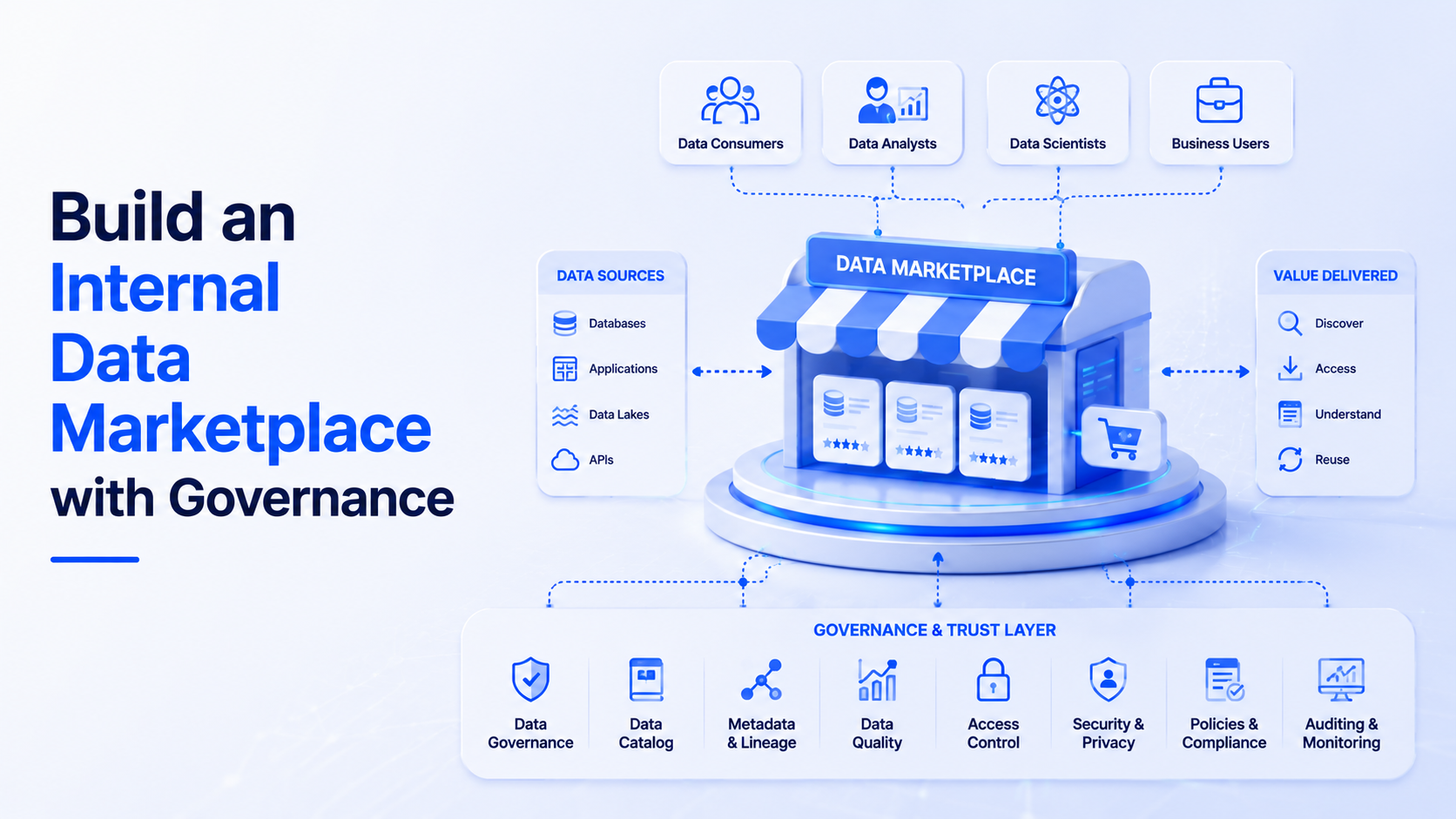
From Tribal Knowledge to Self-Service Data Discovery: How to Build an Internal Data Marketplace That People Actually Use
Every large enterprise eventually invents the same scavenger hunt:
“Who owns this data?”
“Which table is correct?”
“Is there an API already?”
“Can you send me a sample payload?”
“What’s the approval process?”
Weeks later, the team builds a duplicate integration “just to ship.”
This is how organizations become data-rich and execution-poor.
The root problem is not lack of data.
It is the absence of a real internal data marketplace that enables governed, self-service data discovery and immediate delivery.
Elementrix replaces tribal knowledge with a structured enterprise data marketplace where data products are discoverable, requestable through workflow, governed centrally, and consumable via standardized APIs.
The Hidden Cost of Tribal Knowledge in Enterprise Data Discovery
When self-service data discovery does not exist, organizations rely on informal processes:
- Slack conversations
- Email threads
- Ticket chains
- Personal relationships
The result:
- Duplicate integrations across teams
- Inconsistent definitions (e.g., “Customer” means 5 different shapes)
- Slow onboarding cycles
- Shadow access paths
- No measurable data reuse
- Governance gaps
Without a structured data product marketplace, duplication becomes the default behavior.
Why Most Data Catalogs Don’t Fix the Problem
Many enterprises deploy a data catalog expecting it to solve discovery.
But a data catalog is not an internal data marketplace.
Catalogs help you:
- Discover metadata
- See schemas
- Identify tables
They rarely help you:
- Request access in the same flow
- Execute approval workflows automatically
- Enforce field-level entitlements
- Deliver data immediately through API-first interfaces
This is the difference between:
Data Catalog → Documentation
Internal Data Marketplace → Governed Delivery
Elementrix explicitly draws this line.
Catalog and marketplace capabilities can overlap, including access workflows. Before choosing a platform, compare the complete consumer journey and verify how approved access reaches the actual interface. Our data catalog vs data marketplace buyer’s comparison provides a capability table, decision path, and three scenarios to structure that evaluation.
The Shift: From Static Discovery to Executable Internal Data Marketplace
A real enterprise data marketplace must support a continuous path:
Discover → Request → Approve → Consume
When that loop is tight:
- Governance becomes the fastest path
- Teams stop bypassing controls
- Onboarding becomes repeatable
- Data reuse becomes measurable
Elementrix enables this through:
- Published data products with schema exploration
- Domain ownership and stewardship
- Automated approval workflows
- Policy-driven entitlements
- API-first governed delivery
- Usage tracking per consumer
Self-service data discovery becomes executable.
👉 Read more : What Is Data Governance? A Complete Guide
What Changes Culturally with a True Enterprise Data Marketplace
Before
- Data discovery is social
- Approvals are inconsistent
- Consumption requires handholding
- Duplication is common
- Reuse is invisible
After
- Data products are organized by domain
- Ownership is explicit
- Consumers self-serve discovery
- Access follows workflow
- Usage is measurable
- Reuse becomes normal
An internal data marketplace is not just a technical shift — it is a cultural one.
👉 Read more : Top Data Governance Solutions for Secure Data Access
Pragmatic Adoption Path: How to Launch an Internal Data Marketplace
Enterprises often over-engineer adoption.
Instead:
- Start with one domain (Finance, Customer Ops, Sales)
- Publish 3–5 high-demand governed data products
- Provide clear documentation and schema explorer
- Route all new access requests through the marketplace
- Measure onboarding friction
- Optimize time-to-first-consumption
When governed access becomes easier than informal access, behavior shifts naturally.
Metrics That Prove Your Data Marketplace Is Real
A successful internal data marketplace is measurable.
Track:
- Search-to-request conversion rate
- Time-to-first-consumption
- Reuse rate (consumers per product)
- Duplicate integration rate (should decrease)
- Approval cycle time
- Usage metrics per consumer
If reuse increases and duplication declines, the marketplace is working.
👉 Read more : Best Data Governance Tools
How Elementrix Powers a Governed Internal Data Marketplace
Elementrix combines four planes:
Product Plane
- Schema definition
- Versioning
- Domain ownership
- Lifecycle enforcement
Governance Plane
- Entitlements
- Approval workflows
- Field-level access control
- Audit logs
- Kill switch capability
Delivery Plane
- API-first runtime delivery
- Dynamic response shaping
- Standardized interfaces
Observability
- Usage tracking
- Latency monitoring
- Consumer-level metrics
This architecture ensures governed data delivery becomes the fastest and safest path.
Frequently Asked Questions About Internal Data Marketplaces
What is an internal data marketplace?
An internal data marketplace is a platform where governed data products are published, discoverable, requestable through workflow, and consumable via standardized APIs.
How is a data marketplace different from a data catalog?
A data catalog provides metadata visibility.
A data marketplace enables discovery, approval, governance enforcement, and API-based delivery in one unified workflow.
How do you implement self-service data discovery in an enterprise?
To implement self-service data discovery:
- Organize data by domain
- Assign product owners and stewards
- Define clear schemas and semantics
- Embed approval workflows
- Enforce field-level entitlements
- Deliver via API-first architecture
What are the benefits of an enterprise data marketplace?
Key benefits include:
- Faster onboarding
- Reduced duplicate integrations
- Stronger data governance automation
- Increased data reuse
- Measurable data value
- Lower operational friction
How do you measure the success of a data marketplace?
Success metrics include:
- Time-to-first-consumption
- Reuse rate
- Search-to-request conversion
- Reduction in duplicate APIs
- Approval cycle time
- Usage growth per data product
Why do data catalogs fail to drive adoption?
Data catalogs fail when they:
- Separate governance from delivery
- Lack approval workflow automation
- Do not enforce runtime entitlements
- Do not provide standardized API access
Adoption increases when governed access is the fastest path.
Final Thought
Tribal knowledge does not scale.
Static catalogs do not deliver.
A real internal data marketplace combines:
- Self-service data discovery
- Governed data products
- Executable access workflows
- API-first delivery
- Measurable reuse
Elementrix replaces social onboarding with structured, governed, repeatable data delivery — transforming enterprise data from hidden complexity into reusable capital.
👉 Read More : How Governed Data Products Standardize Enterprise Data Delivery