



Telecom Data Delivery Breaks Under Load: Govern Subscriber and Network Data Products with Elementrix
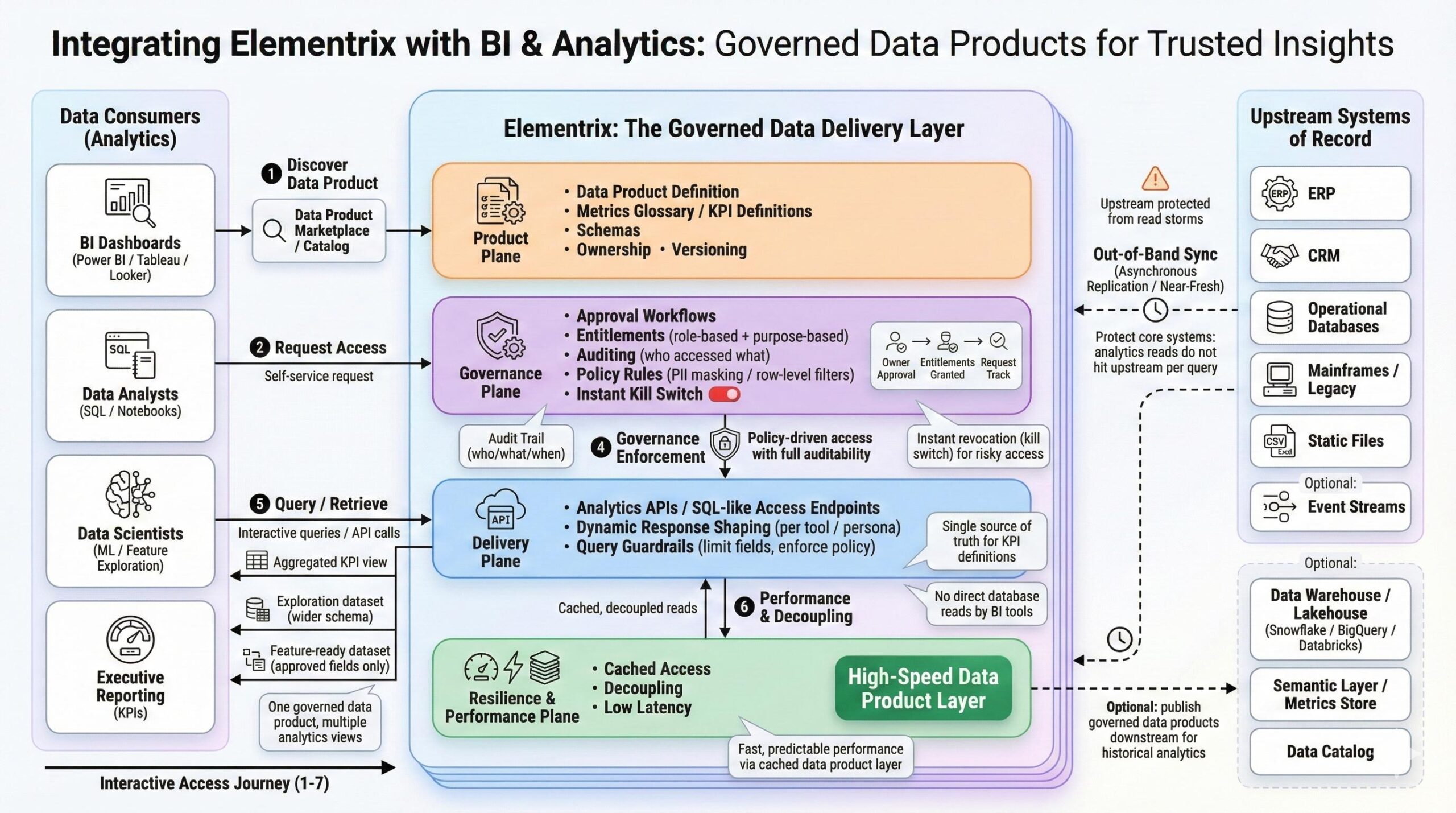
Telecom channels depends on fast, reliable access to subscriber and network data. The mobile self-care app needs low-latency profile and plan information. The web portal needs broader account context. Contact center agents need a richer 360° view. Partners (MVNOs, roaming aggregators) need controlled access with tenant isolation. Analytics teams need trustworthy datasets for churn, revenue, and network KPIs.
In many telecoms, these consumers are served by a mix of OSS/BSS systems—CRM, billing/charging, product catalog, provisioning, NOC monitoring, ticketing—and a growing layer of APIs and integrations. The result is predictable: API sprawl, inconsistent privacy handling, and performance incidents caused by “read storms,” especially during campaigns, outages, and peak hours.
This use case introduces a scalable pattern: Elementrix as a Governed Telecom Data Delivery Layer that turns subscriber and network data into governed data products and delivers them to digital channels, partners, and analytics—through one policy-enforced runtime layer with caching, decoupling, dynamic response shaping, and instant revocation.
Why telecom data access fails in practice
Telecom environments combine three difficult characteristics: high volume, high sensitivity, and high variability in consumers.
Common problems show up quickly:
- Direct OSS/BSS dependency at runtime. Digital channels and partner calls hit CRM or billing systems per request, causing latency and outages to propagate.
- Read storms during spikes. Campaign traffic, roaming surges, and outage events create query floods that degrade core systems.
- Inconsistent PII enforcement. Fields like MSISDN, national ID, address, SIM details, and usage patterns are not handled uniformly across channels.
- Partner risk. MVNOs and roaming partners need access—but telecoms need tenant isolation and instant revocation without redeployments.
- One product, many “views.” Mobile needs lean payloads; agents need expanded context; partners need tiered fields; BI needs analytics-friendly datasets.
Telecoms often solve these with bespoke services. Over time, that becomes expensive, fragile, and hard to audit.
The solution pattern: governed telecom data products delivered by Elementrix
Elementrix sits between telecom consumers and telecom systems of record, and it standardizes data access around governed data products rather than bespoke channel APIs.
In this pattern:
- Consumers call stable endpoints through existing edge components (API gateway, partner portal, identity provider).
- Elementrix enforces governance and shapes payloads based on channel, persona, partner tier, and purpose.
- Data is served from a cached, decoupled high-speed data product layer, synchronized asynchronously from OSS/BSS.
- Usage is metered and logged; access can be revoked instantly with a kill switch.
This turns telecom data delivery into a platform capability rather than a collection of integrations.
Key consumers: digital, partners, and analytics
Telecom data delivery must satisfy very different consumers without creating separate pipelines for each.
Digital channels
- Customer mobile app / self-care
- Web portal
- Contact center / agent desktop
Partner ecosystem
- MVNOs
- Roaming partners
- Aggregators
Analytics
- Revenue and ARPU reporting
- Churn modeling and retention
- Network KPIs, QoE, outages and trouble patterns
A single governed product should support multiple views—without duplicating logic across channel teams.
Telecom systems of record: where the truth lives (and why they must be protected)
Most telecoms rely on OSS/BSS platforms that were not designed to be queried interactively at massive concurrency:
- CRM (customer and accounts)
- Billing and charging (OCS/CCS)
- Product catalog and offers
- Network inventory and provisioning
- Network performance monitoring (NOC)
- Trouble ticketing / ITSM
- Optional: data warehouse/lakehouse, CDR exports, static files
The architectural requirement is not only connectivity—it is protection. Core systems must be shielded from interactive read storms while channels still get low-latency data.
How Elementrix works in telecom: the four-plane model
Elementrix provides governance and delivery across four planes, which map cleanly to telecom requirements.
1) Product plane: define telecom data products as assets
This plane is where subscriber and network datasets become products with contracts.
Examples of telecom data products include:
- Subscriber profile product
- Usage and charges product
- Plan/bundle entitlements product
- Ticket/case status product
- Network experience product (QoE, outages)
- Product definitions and metadata
- Versioning + SLA/freshness expectations
- Ownership and stewardship
This is where you formalize “what a channel can depend on” and how it evolves.
2) Governance plane: enforce PII and partner controls
Telecom is uniquely sensitive: identifiers and usage data require strict controls.
This plane supports:
- Approval workflows (internal + partner onboarding)
- Entitlements (role + partner + purpose)
- PII masking and field filters (e.g., MSISDN partial masking)
- Row-level controls (subscriber-level isolation, tenant scoping)
- Auditing (who/what/when)
- Instant kill switch (partner revoke without redeploy)
3) Delivery plane: runtime APIs with dynamic response shaping
This plane delivers telecom data products through stable endpoints and shapes responses per consumer type.
Typical delivery behavior:
- Mobile/web: lean payloads for speed
- Agent desktop: richer customer context
- Partners: tiered fields + tenant isolation
- BI/analytics: analytics-friendly datasets and broader schema
4) Resilience & performance plane: decouple channels from OSS/BSS
This plane protects core systems while maintaining low latency.
It provides:
- Cached access and materialized views where needed
- Decoupling from upstream systems
- Spike protection during campaigns/outages
- SLA-backed performance via a high-speed product layer
The runtime flow (how a request is served)
This use case can be understood as a clean runtime sequence.
- A consumer (mobile app, agent desktop, partner) calls a stable endpoint through the existing API gateway or partner portal.
- Edge enforcement happens first: authentication, rate limits, traffic shaping, spike control.
- The request is routed to Elementrix for a governed product call.
- Elementrix enforces governance: entitlements, purpose, PII masking, row filters, and auditing.
- Data is retrieved from the decoupled high-speed product layer, not by querying billing/CRM per request.
- Elementrix shapes the payload based on channel or partner tier and returns a PII-safe response.
- Usage and anomalies can be monitored, and access can be revoked instantly if risk is detected.
This is the path that allows “one product, multiple channel views” without exploding the API surface area.
A telecom example: one subscriber product, multiple views
A good test of the architecture is whether you can deliver different experiences from the same governed product.
Consider a “Subscriber Profile + Plan Entitlements” product.
You may need:
- Mobile self-care view: plan name, remaining data, next renewal date, minimal identity info
- Agent view: verified identity fields, contact details, recent complaints, payment status
- Partner view (MVNO): only their tenant’s subscribers, restricted fields, strict rate limits
- Analytics view: aggregated churn indicators and plan migration metrics, no direct identifiers
Elementrix makes this feasible through policy-driven shaping and entitlement rules, rather than building four separate services.
Out-of-band sync: why telecom must replicate near-fresh
If you allow real-time per-request hits to CRM or billing, you will eventually pay for it during spikes and outages. Telecom is a domain where “peak events” are not rare—they are part of business reality.
Out-of-band sync ensures:
- digital channels remain responsive during upstream incidents
- OSS/BSS systems are protected from interactive load
- freshness is managed as an explicit SLA rather than accidental behavior
Sync methods typically include near-fresh replication and caching strategies aligned with product SLAs.
Operational controls: monitoring, audit, and security
Because telecom exposure is high, governance must be operational—not just configuration.
This pattern supports:
- usage metering (volume, spikes, plan limits)
- anomaly detection (unexpected partner behavior)
- observability logs (end-to-end traceability)
- security monitoring integration (SIEM)
- instant revocation using kill switch controls
These are the capabilities that make partner distribution safe at scale.
Developer Checklist Appendix (Telecom Edition)
Data product definition
- Define subscriber and network products with schema, owner, versioning
- Declare freshness SLAs per product (usage vs profile vs tickets)
- Establish change management and deprecation rules
Edge and identity integration
- Route stable endpoints through API gateway / partner portal
- Propagate identity and tenant context to Elementrix
- Apply rate limits and spike control by channel and partner tier
Governance enforcement
- Implement entitlements by role + purpose + partner tier
- Enforce tenant isolation (MVNO/roaming) via row-level filters
- Apply PII masking/field filters (MSISDN, address, IDs)
- Enable auditing with product version + policy decision context
- Define kill-switch authority and incident procedures
Delivery and shaping
- Create channel-specific shaped views from the same product
- Add guardrails: payload limits, query limits, timeouts, concurrency caps
- Standardize denial behaviors (policy-based error responses)
Performance and resilience
- Serve from cached/high-speed product layer for predictable latency
- Prevent direct per-request hits to OSS/BSS
- Load test peak scenarios (campaigns, outage spikes, roaming surges)
- Monitor p95 latency, error rates, freshness compliance
Monitoring and security
- Meter usage for anomalies and partner tier enforcement
- Integrate logs with SIEM and operational monitoring
- Maintain end-to-end traceability for compliance inquiries